We are moving towards the next phase of this mega “Read the Defence” series. If you haven’t read the earlier editions, have listed below.
Post 1 : India’s Defence Decade Has Begun
Post 2 : The Defence Value Chain
Post 3 : How to Read a Defence Company
Moving on to the next post which is about what to track for these businesses in the defence sector. Lets go!
Defence companies are not like most businesses you track in an equity portfolio.
In consumer goods, a single quarterly earnings report tells you most of what you need to know — volumes, pricing, margins, channel inventory. The feedback loop between the business and the market is tight. Results move stocks.
In defence, the quarterly P&L is almost a lagging indicator. Revenue is recognised on milestone achievement for long-cycle contracts. Margins shift based on product mix that changes annually, not quarterly. PAT is inflated by customer advance interest income that has nothing to do with operational performance in that specific quarter.
The leading indicators — the variables that tell you where revenue, margins, and order inflows are going before they show up in the financial statements — sit outside the P&L entirely.
This post identifies the 10 most important ones. These are the variables I check every quarter before forming a view on any of the eight listed defence companies covered in this series.
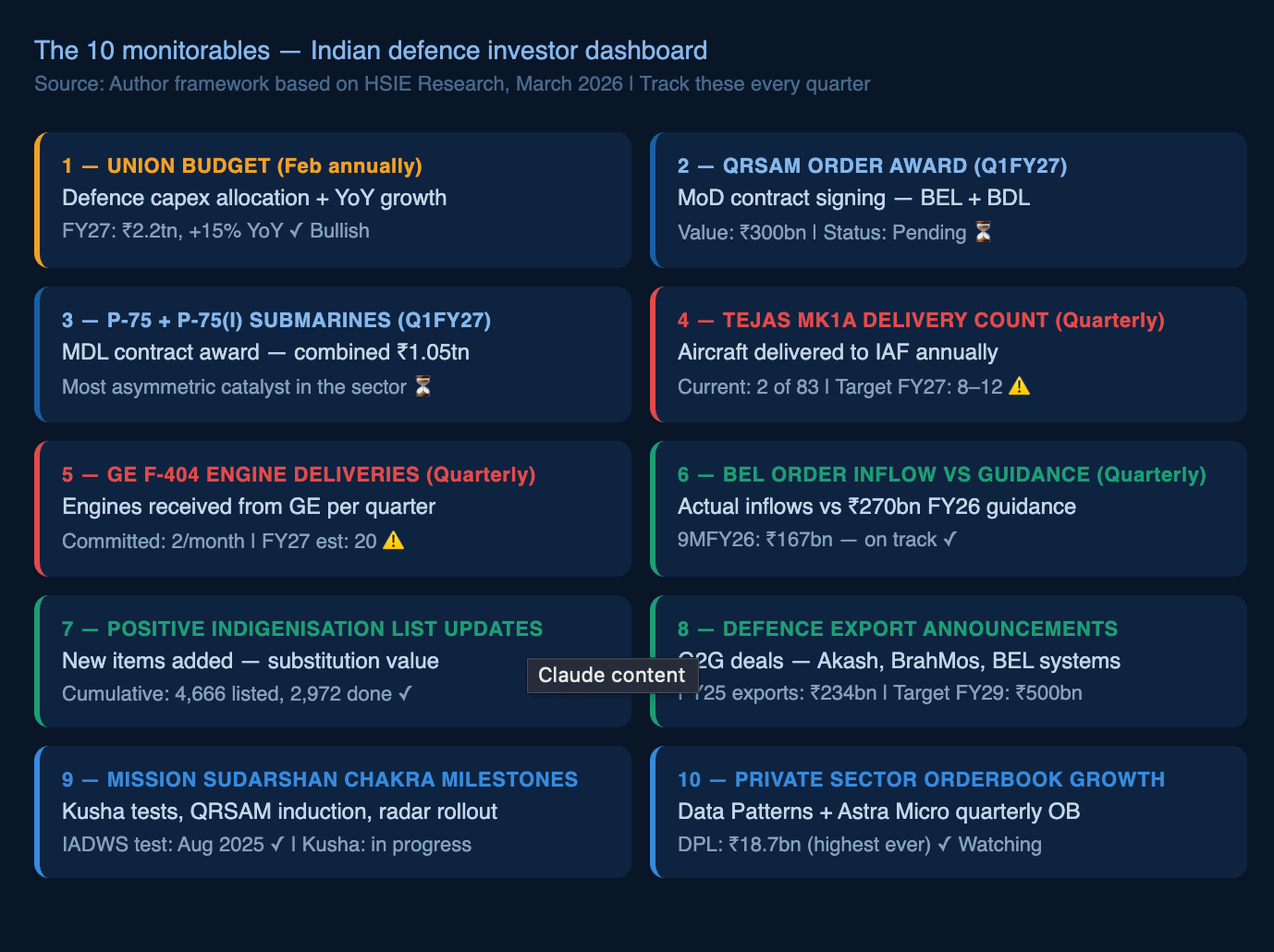
Monitorable 1 — Union Budget: Defence Capex Allocation
When: Every February, at Union Budget presentation.
What to track: Total defence capex allocation in absolute INR terms, and year-on-year growth rate. Separately track the capex split between Air Force, Navy, and Army — the service-wise allocation determines which companies benefit most in that budget cycle.
Why it matters: Every defence company’s order inflow guidance for the coming year is anchored to this single number. The INR 2.2 trillion capex allocated in FY27 — growing 15% YoY — is the direct demand pipeline feeding BEL, HAL, MDL, BDL, and the private sector players. Any year where capex growth falls below 8% should be treated as a sector-level negative surprise. Growth above 12% is the structural baseline that sustains current valuations.
The FY27 read: INR 2.2 trillion, +15% YoY, with Air Force continuing to command the largest share. Bullish for HAL and BEL specifically.
What to watch in FY28: Whether the government maintains or accelerates capex growth given the geopolitical environment. Any fiscal consolidation that trims defence capex disproportionately would be the single largest risk to sector earnings estimates.
Monitorable 2 — QRSAM Order Award
When: Expected Q1FY27.
What to track: Ministry of Defence contract signing announcement. Specifically — contract value confirmation, delivery timeline, and split between BEL (radar and electronics integration) and BDL (missile manufacturing).
Why it matters: At INR 300 billion, QRSAM is the single largest near-term order catalyst in the sector. BEL has guided this order for Q1FY27 — it is already in their forward guidance assumptions. A delay of even one quarter creates an earnings miss against consensus estimates. An on-time award triggers an immediate re-rating.
For BDL, QRSAM is an existential execution catalyst — the company needs this order to demonstrate that its FY25–28E revenue CAGR of 21.4% is achievable rather than aspirational.
Signal to watch: Any MoD press release on contract finalization, or management commentary in quarterly results about QRSAM status.
Monitorable 3 — P-75 Additional + P-75(I) Submarine Contract Awards
When: Expected Q1FY27 for both.
What to track: MoD contract award for the three additional Scorpene-class submarines (P-75 additional, INR 350 billion) and the six AIP submarines (P-75(I), INR 700 billion) with the MDL-TKMS consortium.
Why it matters: For MDL, these two contracts are transformational. The current book-to-bill of 2.8x would surge to 8x+ overnight. The combined INR 1.05 trillion in new orders would provide revenue visibility through FY34. MDL’s management has guided that these orders, once received, will take the total orderbook above INR 1.2 trillion.
This is the most asymmetric single-event catalyst in the entire sector — a binary event that, if it fires in Q1FY27 as guided, would represent MDL’s largest-ever orderbook addition in a single quarter.
Signal to watch: Any announcement from MoD or MDL management on commercial negotiations status for P-75(I). The P-75 additional (repeat Scorpene order) is closer to finalization and likely to arrive first.
Monitorable 4 — LCA Tejas MK1A Annual Delivery Count
When: HAL quarterly management commentary. Annual confirmation with full-year results.
What to track: Number of Tejas MK1A aircraft delivered to IAF in the financial year.
Why it matters: This is HAL’s primary manufacturing revenue driver for FY26–FY29. The delivery count is the most direct measure of whether the execution acceleration thesis is materialising.
The benchmark: below 8 aircraft in FY27 = execution concern, earnings miss risk, stock pressure. Between 8–12 = on-track, in line with revised guidance. Above 12 = acceleration signal, consensus earnings upgrades begin.
Context: only 2 aircraft have been delivered from a contract signed in 2021 for 83. The entire HAL investment thesis for FY27–29 rests on this number stepping up materially.
Monitorable 5 — GE F-404 Engine Delivery Confirmation
When: HAL quarterly management commentary.
What to track: Number of GE F-404 engines received per quarter. GE’s committed rate is 2 per month (24 per year). Estimated delivery: 20 engines in FY27.
Why it matters: This is HAL’s single-point supply chain risk — the one variable outside HAL’s control that determines the Tejas production rate. GE has already caused one major disruption (2022–2024) that delayed the programme by 4+ years. Any recurrence — supply chain disruption, geopolitical friction between India and USA affecting defence exports, GE manufacturing backlog — resets the entire delivery timeline.
Conversely, any acceleration above the 2-per-month committed rate is an upside signal that the market would price immediately.
Signal to watch: GE’s quarterly earnings calls for any commentary on F404 production capacity. HAL management updates on engine inventory at its Bengaluru facility.
Monitorable 6 — BEL Order Inflow vs Guidance
When: Every quarter with results. Full-year guidance reiteration at annual results.
What to track: Actual order inflows received in the quarter vs the full-year guidance of INR 270 billion (FY26, ex-QRSAM). Specifically watch for large ticket awards — QRSAM (INR 300 billion), next generation corvette electronics (INR 80 billion), Project Kusha (INR 400 billion by FY29).
Why it matters: BEL’s 45x FY28E valuation premium is sustained by its track record of delivering on order inflow guidance consistently. The H1FY26 achievement of INR 125 billion and Q3FY26 total of INR 167 billion are on track for the INR 270 billion full-year guidance. Any quarter where the run rate implies a guidance miss triggers de-rating pressure.
BEL has never materially missed its own order inflow guidance in recent years — which is why it trades at a premium to all other DPSUs. Maintaining that track record is as important as the absolute order number.
Monitorable 7 — Positive Indigenisation List Updates
When: MoD notifications — typically 1–2 per year, irregular timing.
What to track: New items added to the PIL. Cumulative substitution value. Specifically watch for electronics and avionics categories — these directly expand BEL, Data Patterns, and Astra Microwave’s addressable markets.
Why it matters: Each PIL update is a permanent, policy-mandated expansion of the domestic addressable market. The cumulative list has reached 4,666 items with INR 34 billion in substitution value — but this represents only a fraction of India’s total defence import basket. Each new list tranche is a positive catalyst for the domestic electronics supply chain.
What to watch: Any PIL notification that includes AESA radar components, EW subsystems, or missile electronics — these are the highest-value categories and would most directly benefit the private sector electronics players.
Monitorable 8 — Defence Export Announcements
When: MoD press releases, company investor days, quarterly results commentary.
What to track: Government-to-government export deals (Akash missile system, BrahMos, Tejas aircraft). BEL system-level exports (radar systems, coastal surveillance). HAL aircraft exports (Do-228, helicopters). BDL torpedo and ATGM exports.
Why it matters: India’s defence exports grew 34x in a decade to INR 234 billion in FY25, against a government target of INR 500 billion by FY29. Export orders have a compound effect — they signal international credibility, diversify revenue away from single-customer MoD concentration, and often carry better margin profiles than domestic nominated contracts.
For BEL specifically: management targets growing exports from 4–5% to 10% of revenue within 3–5 years. Any large G2G deal announcement (even a letter of intent) would be a positive re-rating catalyst.
Monitorable 9 — Mission Sudarshan Chakra Programme Milestones
When: MoD announcements, DRDO test result releases.
What to track: Project Kusha interceptor test milestones (M1/M2/M3 variants). QRSAM induction progress. VSHORAD development status. Radar network deployment announcements (the programme envisions 6,000–7,000 cross-linked radars). IADWS integrated test results (the August 2025 test was successful — watch for follow-on tests).
Why it matters: MSC is a potential INR 1–2 trillion procurement programme running from 2025 to 2035. It is the single largest future order pipeline for BEL (radars, C2, air defence electronics), BDL (QRSAM and interceptor missiles), and indirectly Data Patterns and Astra Microwave (radar subsystems). Each programme milestone confirms the architecture is advancing and procurement is imminent.
The status as of March 2026: IADWS prototype tests completed successfully in August 2025. Project Kusha in accelerated development phase. The programme is real and moving — but commercial procurement contracts are still 1–2 years away for most components.
Monitorable 10 — Private Sector Orderbook: Data Patterns and Astra Microwave
When: Quarterly results.
What to track: Total orderbook size (Data Patterns: currently INR 18.7 billion including negotiated pending receipts, targeting INR 20–30 billion pipeline over next 2 years). Mix between developmental and production orders — the shift toward production is margin-accretive. Export orderbook as a percentage of total.
Why it matters: At their current revenue bases (Data Patterns: INR 7 billion, Astra Microwave: INR 10.5 billion), a single large order award can add 30–50% to the total orderbook in one quarter. These are the highest-beta quality names in the sector — high margins, strong IP, but small enough that individual order wins are transformational.
For Data Patterns: To watch the AMCA tripartite agreement progress (signed with Bharat Forge and BEML in September 2025) and any Project Kusha order announcement.
For Astra Microwave: watch the Virupaksha radar DcPP order (selected with BEL for Super Sukhoi upgrade) and QRSAM subsystem contracts.
How to Use This Framework
These 10 monitorables do not all matter equally at all times. The relative importance shifts with the news cycle and the programme cycle.
Right now — in the March 2026 context — Monitorables 2, 3, 4, and 5 are the most time-sensitive. The QRSAM and submarine contract awards are imminent events. The Tejas delivery count for FY27 will be the first real test of whether HAL’s execution acceleration is real. GE engine delivery confirmation underpins the entire HAL thesis.
Build a simple quarterly tracker — a spreadsheet with these 10 variables, updated each quarter with what was announced vs what was expected. Over time, the companies that consistently deliver positive readings across these variables are the ones where the earnings upgrade cycle is building. The ones that consistently miss are the ones where premium valuations are vulnerable.
The quarterly P&L is the scoreboard. These 10 variables are the game being played.
Next post: My portfolio construction framework for Indian defence — how to size exposure, which segments to weight, and what the risk factors are that could break the thesis.
This series is based on detailed analysis of HSIE’s 286-page institutional defence sector report, March 2026.
Earlier Posts
Post 1 : India’s Defence Decade Has Begun
Post 2 : The Defence Value Chain
Post 3 : How to Read a Defence Company