We are moving towards the second half of this mega “Read the Defence” series. If you haven’t read the earlier editions, have listed below.
Post 1 : India’s Defence Decade Has Begun
Post 2 : The Defence Value Chain
Post 3 : How to Read a Defence Company
Post 4 : The 10 Monitorables: What to Track Every Quarter
Post 5 : This one !
Do read the others to get a better context of the next ones.
There is a particular kind of investment trap that is almost impossible to avoid if you are new to defence sector analysis.
It goes like this. You find a company with an enormous order book — the largest in the sector, backed by the government, building products that India cannot source from anywhere else. You conclude that revenue visibility is exceptional and the stock is a long-term buy. You are correct about the order book. You are correct about the strategic indispensability. And you may still be wrong about the investment at the current price.
HAL is that company right now.
Hindustan Aeronautics Limited carries an estimated order backlog of INR 2.4 trillion — the largest among all listed Indian defence companies. It holds a Maharatna status, the highest classification for a government enterprise. It is India’s only fighter aircraft manufacturer, its only helicopter manufacturer of scale, and the custodian of maintenance and overhaul for approximately 80% of India’s active military fleet. There is no competitor. There will not be one for at least a generation.
But not many analysts/FIIs/DIIs/PMSs are excited about it.
This post is about why. Not because the long-term thesis is wrong — it isn’t — but because understanding the gap between a great company and a great investment is the most important skill in equity analysis.
The Order Book Paradox
HAL’s order book has been growing for six consecutive years. The book-to-bill ratio expanded from 2.9x in FY19 to 7.1x by FY25-end — and with the additional 97 LCA Tejas MK1A order (INR 623.7 billion, received September 2025), it now sits at an estimated 6.2x FY28E revenues.
In most sectors, a rising book-to-bill signals accelerating demand. In HAL’s case, the rising book-to-bill has a second explanation — one that changes the interpretation entirely.
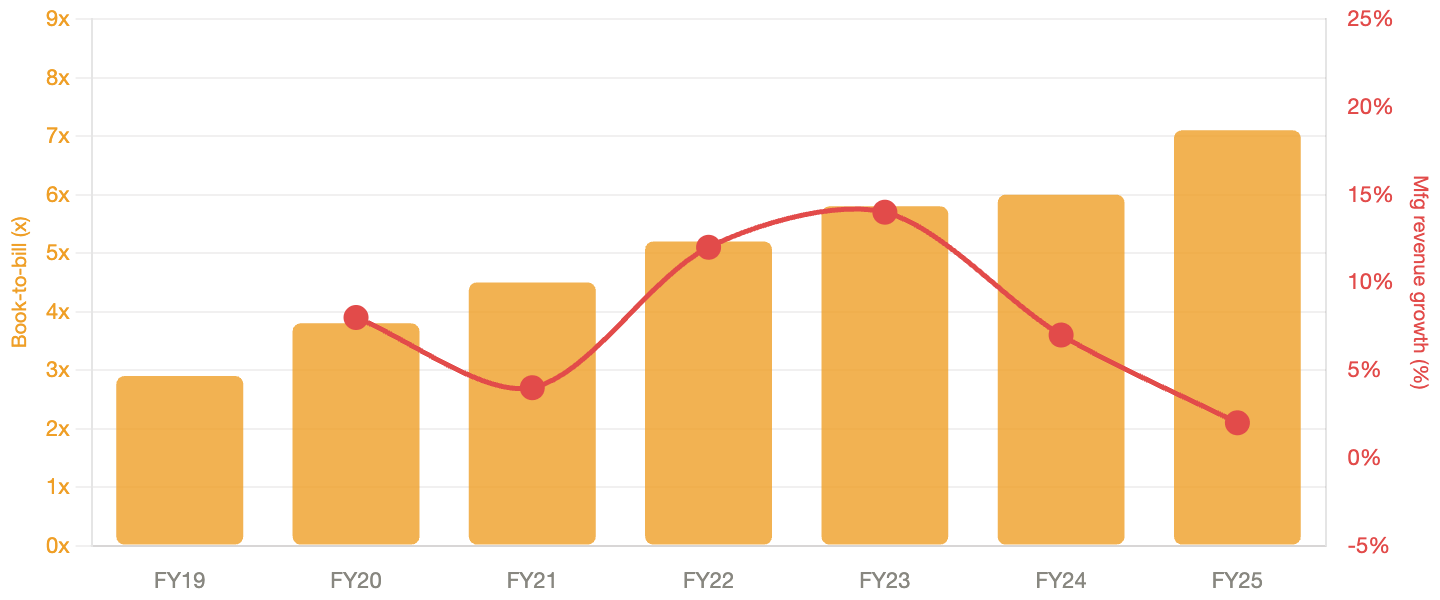
HAL: book-to-bill rising vs manufacturing revenue CAGR flat] Dual bar chart: book-to-bill rising from 2.9x (FY19) to 7.1x (FY25) on left axis. Manufacturing revenue CAGR annotation showing 7.8% over FY19-25. HAL’s order book expanded rapidly while manufacturing revenue CAGR stayed at 7.8% — the divergence between the two is the execution gap. Source: company filings.
HAL’s manufacturing revenue — the segment that should be the primary beneficiary of new platform order inflows — grew at only 7.8% CAGR during FY19–25. Over the same period, the book-to-bill nearly doubled. The order book was accumulating faster than it was being executed. That is not a demand story. That is an execution bottleneck story.
The GE Engine Constraint: A Case Study in Single-Point Supply Chain Risk
The specific bottleneck is worth understanding in detail because it reveals a systemic vulnerability in India’s defence aerospace ecosystem.
HAL signed a contract for 83 LCA Tejas MK1A aircraft in 2021 — India’s largest-ever aerospace manufacturing contract at the time, valued at INR 480 billion. The aircraft is powered by the GE Aerospace F404-IN20 engine, sourced from the United States.
Engine deliveries began falling behind schedule in 2022 due to global manufacturing backlogs and supply chain disruptions at GE’s facilities. By 2023–24, the shortfall had become the primary constraint on HAL’s production line. Airframes were being completed at HAL’s Bengaluru facility — structural work done, systems integrated — but could not proceed to final assembly and flight testing without engines. Completed airframes sat waiting.
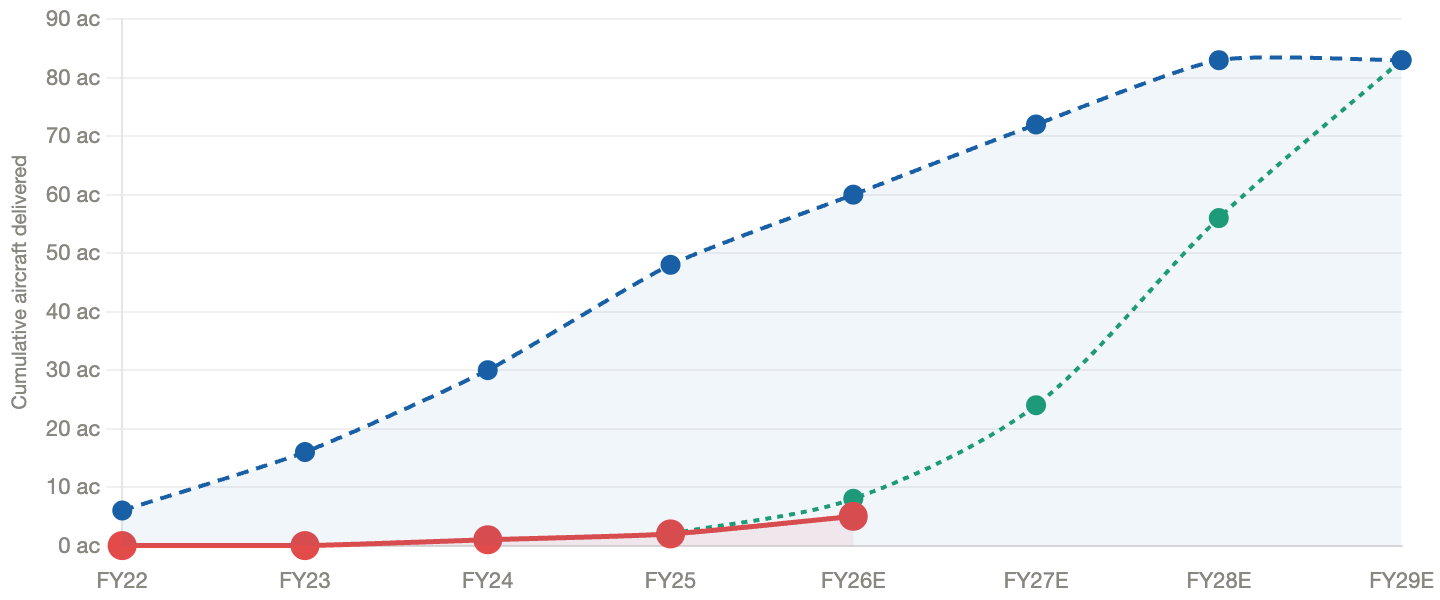
Tejas MK1A: deliveries actual vs timelineTimeline bar: Contract signed 2021, target delivery schedule vs actual. Actual deliveries: 2 aircraft by early 2026 vs original schedule implying 10–12+ by this point. Only 2 of 83 contracted LCA Tejas MK1A have been delivered as of early 2026. Engine supply constraints have materially delayed the programme.
Source: HSIE Research, HAL management guidance
As of early 2026, two aircraft have been delivered from a contract signed in 2021 for eighty-three. The engines resumed delivery in 2025 — GE delivered four engines between March and September 2025 and committed to supplying two per month thereafter. GE is estimated to deliver approximately 20 engines in FY27, enabling meaningful aircraft deliveries to resume.
HAL has added a second production line at its Nashik facility targeting 24 aircraft per year post-FY27. Management guidance is to complete the first order of 83 aircraft by FY29 — four years behind the original schedule. The second order of 97 aircraft (INR 623.7 billion) begins delivery from FY29 and extends through FY34.
The lesson is not that HAL is poorly managed. The lesson is that a programme of this complexity, with critical components sourced from a single foreign supplier, carries inherent single-point supply chain risk that has already materialised once and could materialise again.
The Financial Arithmetic of the non excitement
I think that we need to work through the valuation arithmetic carefully.
HSIE estimates HAL’s PAT CAGR at 9.3% over FY25–28E — growing from INR 56.5 billion in FY25 to an estimated INR 74.8 billion in FY28E. This growth assumption is based on: MRO revenues growing at 8–10%, manufacturing revenue accelerating as engine supply normalises, and margins stabilising at 22–23% EBITDA.
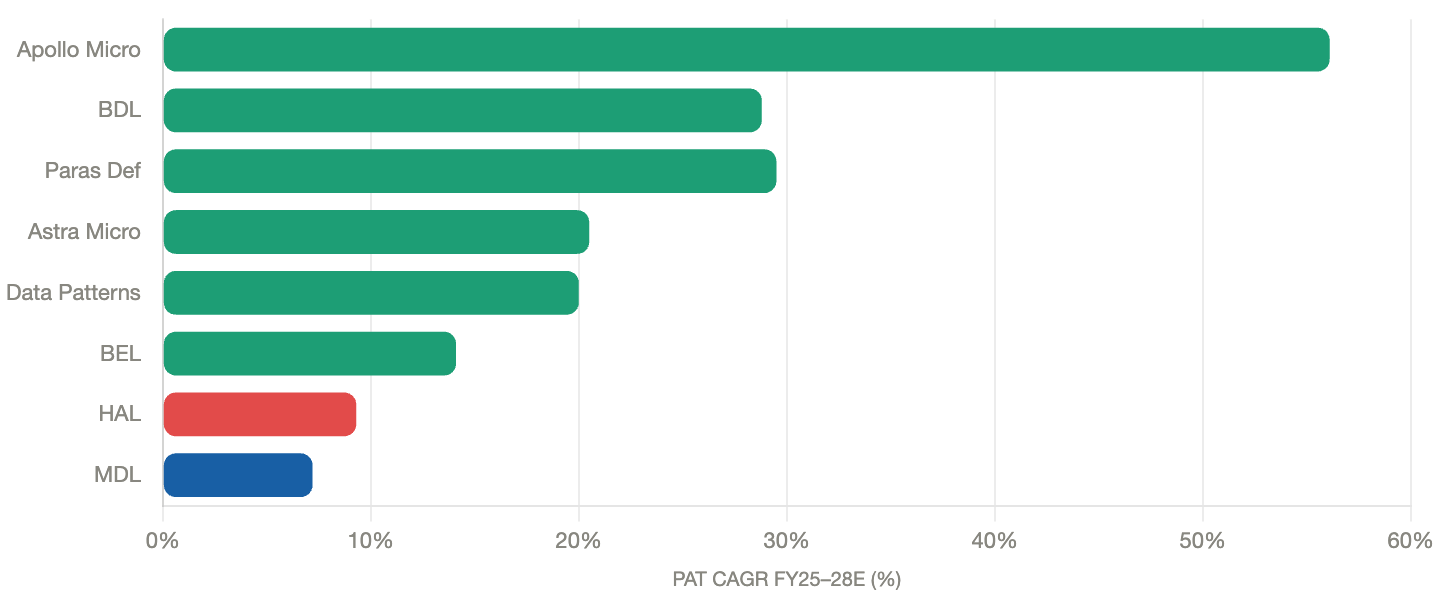
PAT CAGR comparison: HAL vs peers
BDL 28.8%, Data Patterns 20%, Astra Micro 20.5%, BEL 14.1%, HAL 9.3%, MDL 7.2%
Currently HAL trades at approximately 24x FY28E earnings. The institutional target prices are in range of 3000-3400 whihc implies 20x FY28E — a modest de-rating that reflects the view that HAL’s execution track record does not yet justify the premium implied by current prices.
The comparison that crystallises the valuation concern: Data Patterns trades at 55x FY28E earnings but is delivering 20% PAT CAGR, 38–39% EBITDA margins, zero foreign component dependency in its supply chain, and an orderbook that is transitioning from developmental to production phase with high visibility. HAL at 24x is not cheap relative to a 9.3% PAT CAGR and material execution risk.
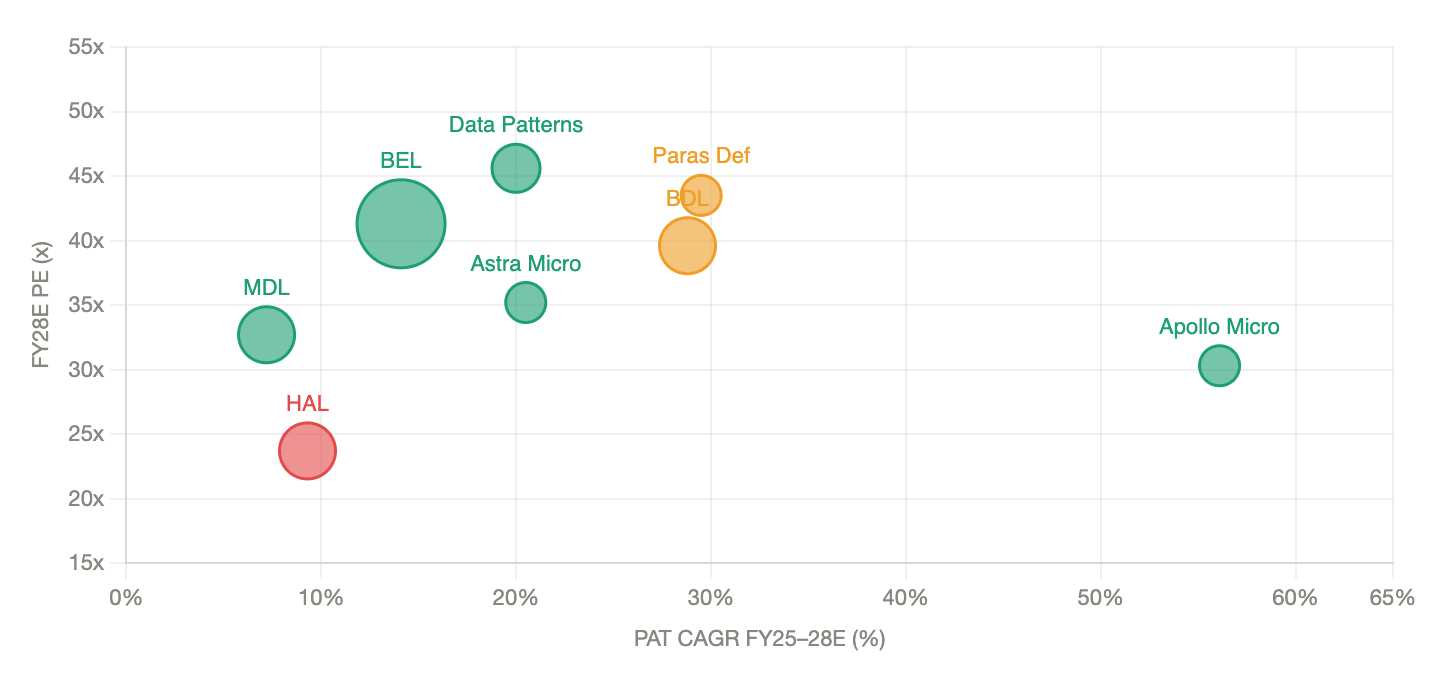
Valuation vs PAT CAGR: bubble chart across covered companies: HAL sits at low CAGR / moderate PE. Data Patterns at high CAGR / high PE.
Am I reading it incorrectly ?
This is worth being explicit about, because this post about HAL numbers will feel counterintuitive to most readers of this series.
It is not saying HAL is a bad business. HAL’s MRO monopoly — 50% of revenues, recurring, sole-source, compounding with every platform inducted into service — is one of the highest-quality revenue streams in Indian equities. A company that has built over 4,200 aircraft and 5,200 engines has a captive maintenance business that generates cash regardless of what happens with new platform delivery timelines.
It is not saying the long-term story is broken. The LCA Tejas MK2 (120–200 aircraft, potentially INR 1.5 trillion+), AMCA (126 aircraft, INR 1,570 billion), LCH Prachand (156 helicopters, INR 628 billion), and LUH programmes collectively make HAL the central node of Indian aerospace for the next three decades. There is genuinely no alternative to HAL for fighter aircraft production in India. That monopoly is permanent.
It is not saying to sell and never look back.
What the post & the money flow saying:
At current prices, the market has already priced in the execution recovery that GE engine supply normalisation enables. The base case — 16–24 aircraft delivered per year from FY27–28 onward — is fully reflected in the current valuation. There is no margin of safety for the scenario where the supply chain hits another disruption, where certification timelines slip, or where the new Nashik production line takes longer to ramp than projected.
The asymmetry is unfavourable. The upside from here requires everything to go right. The downside materialises if anything goes wrong — and something has already gone wrong once.
The Broader Investment Principle
HAL gives an important gyan that applies across every sector, not just defence.
A great company and a great investment are not the same thing. They share many qualities — durable competitive advantage, long revenue visibility, strategic necessity. But a great investment also requires that the price you pay leaves room for error. Its all about Risk Reward ratio.
The investors who shall make money in HAL are those watching two specific triggers:
Trigger 1 — Price. A correction in the current prices would represent a materially better entry point where the execution risk is priced in rather than ignored.
Trigger 2 — Execution. When HAL delivers 12+ Tejas MK1A aircraft in a single financial year — demonstrating that the production ramp is real and the engine supply is stable — the earnings upgrade cycle begins and the valuation conversation changes.
Neither trigger has fired yet. Which is precisely why the Institution buying is not happening.
What to Watch
The specific monitorables for HAL over the next 4–6 quarters:
GE F-404 engine delivery confirmation each quarter — any disruption resets the timeline. Tejas MK1A delivery count — the annual figure needs to step up from 2 to 8–12 to validate the FY27 acceleration thesis. LCH Prachand production commencement from FY28 — this programme (INR 628 billion, 156 helicopters) is the next major manufacturing revenue driver after Tejas. AL-31FP aero engine production (30 units per year for 8 years contracted) — a steady, lower-profile revenue contributor that provides a manufacturing base while the flagship programmes ramp.
Next post: Mission Sudarshan Chakra: Why India Is Building a National Defence Shield — and Who Benefits , we will map the full architecture and what it means for the companies that build it.
This series is based on detailed analysis of HSIE’s 286-page institutional defence sector report, March 2026.