We are moving towards the second half of this mega “Read the Defence” series. If you haven’t read the earlier editions, have listed below.
Post 1 : India’s Defence Decade Has Begun
Post 2 : The Defence Value Chain
Post 3 : How to Read a Defence Company
Post 4 : The 10 Monitorables: What to Track Every Quarter
Post 5 : HAL: India’s Greatest Order Book
Do read the others to get a better context of the next ones. Now , Let’s go !
On 15 August 2025, India’s Prime Minister stood at the Red Fort and announced a programme that received surprisingly little coverage in financial media.
It was called Mission Sudarshan Chakra (MSC)— named after the spinning discus weapon of Lord Vishnu in Hindu mythology. A weapon that, once released, pursues its target autonomously and returns to its owner after striking.
The symbolism was deliberate. MSC is India’s most ambitious attempt to build a fully integrated, multi-layered, nationally sovereign air and missile defence shield — one that detects threats early, engages them at multiple ranges, and operates under a unified AI-enabled command and control architecture.
The programme’s procurement budget over a decade is estimated at INR 1–2 trillion.
Just like me, most retail investors have not heard of it. Most financial analysts are aware of individual components — QRSAM, Project Kusha — but have not mapped the full architecture and what it means for the companies that build it.
This post does both.
Part 1: The Threat Context — Why India Needs This Now
The case for Sudarshan Chakra starts not with a budget line but with a map.
India shares 3,488 kilometres of contested, actively patrolled border with China — including the Line of Actual Control in Ladakh where physical confrontations occurred as recently as 2020. It shares 3,323 kilometres with Pakistan — a nuclear-armed adversary with whom India has fought four wars and maintains a state of permanent low-level friction.
Both neighbours have been rapidly expanding their drone and precision strike capabilities. China has the world’s most advanced drone manufacturing industrial base — producing both military and commercial UAVs at a scale no other nation matches. Pakistan has been acquiring armed drones from China and Turkey and has demonstrated loitering munition capability.
The Ukraine conflict — now in its fourth year — has provided a brutal real-world demonstration of what a well-coordinated drone-missile attack can achieve against a militarily capable adversary. Ukrainian and Russian forces have both used drone swarms to overwhelm point air defence systems, neutralise radar installations, and strike strategic assets hundreds of kilometres behind the front line. The cost asymmetry is staggering — a $500 drone delivering a shaped charge against a $50 million radar system.
India’s current air defence architecture was not designed for this threat environment.
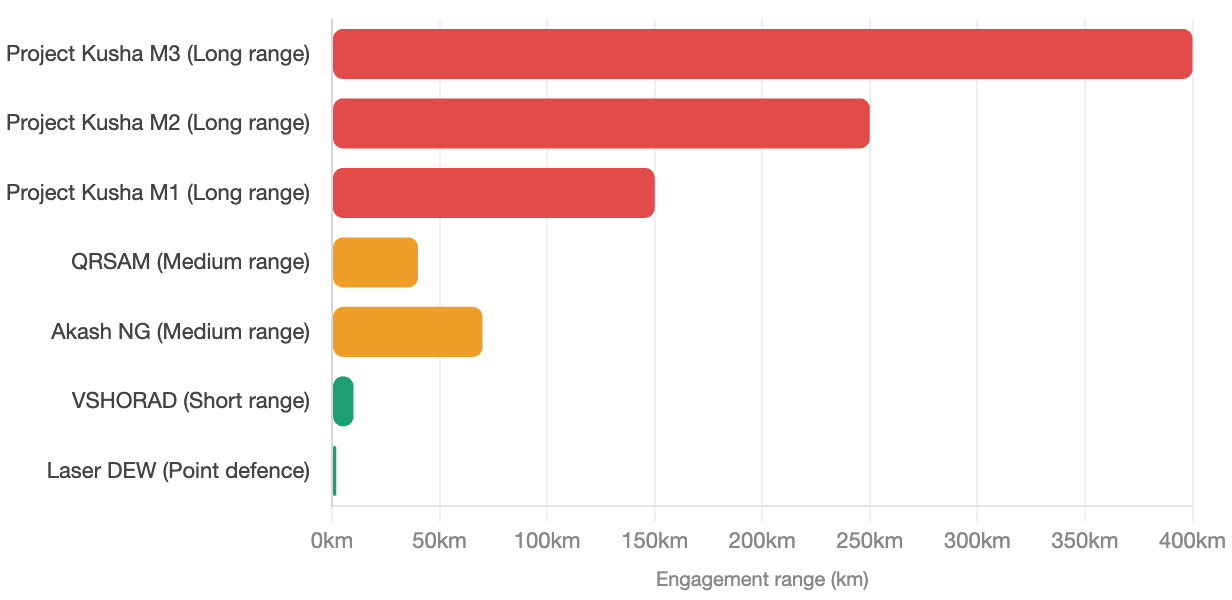
India’s existing air defence systems — S-400, Akash, VSHORAD — operate as disconnected layers without unified command. MSC is designed to integrate them. Source: HSIE Research, DRDO, author analysis.
The S-400 batteries India purchased from Russia provide long-range area defence — capable of engaging ballistic missiles and aircraft at ranges up to 400km. But they are static, expensive to operate, and geopolitically vulnerable given Russia’s current international isolation and the sanctions environment.
The Akash missile system provides medium-range mobile defence — effective against aircraft and some cruise missiles at ranges up to 25–30km. It is deployed in regiments across the armed forces but operates as a standalone system.
VSHORAD units provide point defence for specific assets — forward airbases, radar installations, command centres — against low-altitude threats including helicopters and slow drones.
The critical vulnerability: these systems are not integrated. They do not share a common operational picture. A coordinated attack that sequences threats — first a drone swarm to identify and partially degrade radar coverage, then a cruise missile strike through the revealed gap, then a ballistic missile at the defended asset — can exploit the seams between disconnected systems.
Mission Sudarshan Chakra is the architecture designed to eliminate those seams.
Part 2: The Programme Architecture
MSC is not a single weapon system. It is a national defence architecture — a framework that integrates existing and new systems under a unified command and control layer, adds new capability at multiple engagement ranges, and builds the sensor network to provide early warning across the full threat spectrum.
The architecture has four functional layers and one nervous system.
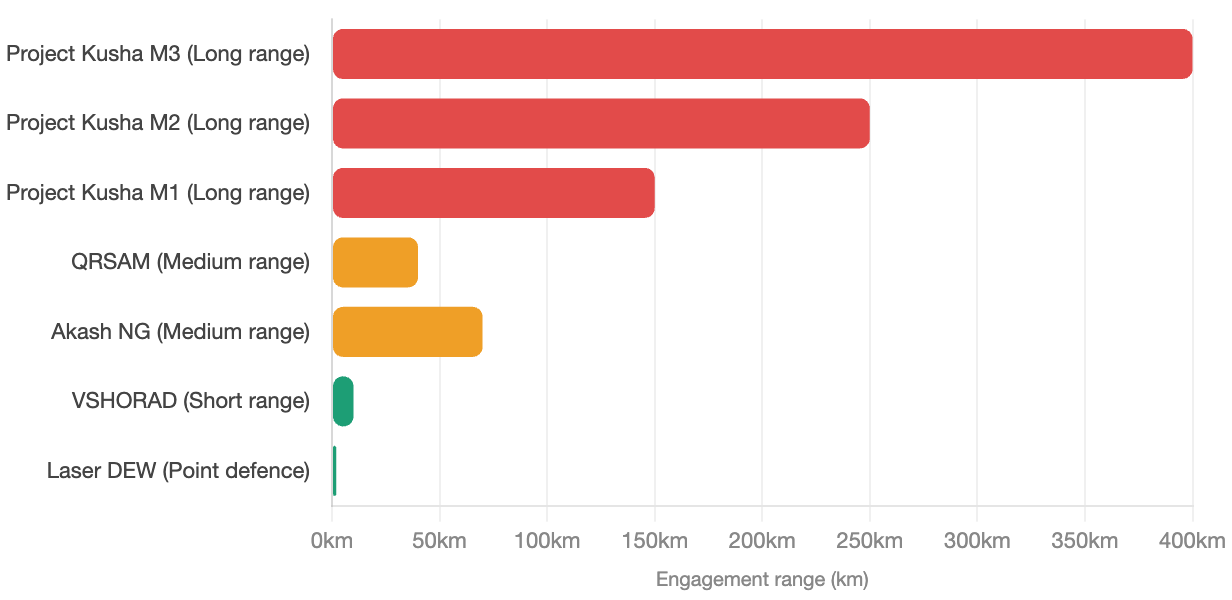
MSC layered architecture diagram: Four engagement layers from VSHORAD (shortest range) to Project Kusha M3 (longest range), with the radar + satellite nervous system shown separately.
Layer 1 — Long Range Area Defence: Project Kusha
Project Kusha is India’s indigenous long-range surface-to-air missile programme — designed to fill the capability gap between the MRSAM (100km range) and the S-400 (400km range). It is the strategic centrepiece of MSC.
The programme delivers a family of interceptors in three variants: M1 with approximately 150km range, M2 with approximately 250km range, and M3 with approximately 350–400km range — with a longer-range variant under development. The system is designed for area denial, air defence, and counter-ISR roles — and is intended to progressively replace S-400 dependence over the decade.
BEL is the prime industry integrator. DRDO leads design through its labs at LRDE (radar), RCI (seekers), and DLRL (electronic warfare). The Cabinet Committee on Security approved the programme in May 2022. Initial funding tranches for five IAF squadrons were approved in 2023 — estimated at INR 217 billion for early squadrons and prototyping.
Layer 2 — Mobile Short-to-Medium Range: QRSAM
QRSAM — Quick Reaction Surface to Air Missile — is the programme immediately upstream of Akash in the engagement range hierarchy. With a 25–40km engagement range and the critical ability to track and engage threats while on the move, QRSAM addresses the specific operational requirement to protect fast-moving mechanised columns and forward airbases in high-intensity conflict.
The programme completed developmental trials in 2017–2022 and has entered the procurement phase. The headline acquisition plan totals approximately INR 300 billion for several regiments. BEL integrates the radar, command and control, and launcher electronics. BDL manufactures the missiles.
Layer 3 — Very Short Range: VSHORAD
VSHORAD provides the final engagement layer — point defence for critical assets against low-altitude, slow-moving threats including drones, helicopters, and cruise missiles in their terminal phase. BDL is developing the VSHORAD system with a new manufacturing facility planned at Amravati specifically for this programme.
Layer 4 — Directed Energy Weapons
This is the most forward-looking layer — and the one that received the least coverage despite being the most strategically significant.
The August 2025 IADWS test integrated a 5kW laser DEW with missiles and VSHORAD under a single C2 system. This was not a demonstration — it was a proof of concept for the cost economics of layered defence. A laser engagement costs a fraction of a missile engagement. Against drone swarms — where the adversary can field hundreds of low-cost threats simultaneously — the only economically sustainable response is a directed energy weapon that costs pennies per engagement rather than lakhs.
India’s laser DEW programme is in its early stages. The 5kW system is a starting point. The roadmap envisions higher-power systems (50kW+) capable of engaging faster and more resilient targets. This layer will become increasingly important as drone technology advances.
The Nervous System: Sensors, Satellites, and AI
The programme envisions 6,000–7,000 cross-linked radars forming a continuous sensor fabric across India’s airspace — supplemented by ISR satellites for over-the-horizon detection and AI-enabled command and control for automated threat classification and engagement sequencing.
This sensor layer is what transforms MSC from a collection of missile systems into an integrated national defence architecture. Without it, the engagement layers operate in isolation — the same vulnerability that exists today. With it, a threat detected by a radar in Ladakh can trigger an engagement response from a system in Punjab within seconds.
Part 3: The Test That Proved It’s Real
Sceptics of large Indian defence programmes have historical justification. India has a long record of ambitious programme announcements that face years of delay before materialising into hardware.
MSC has a specific data point that separates it from aspirational policy: the August 2025 IADWS test.
In the same month the programme was announced, DRDO successfully conducted the maiden integrated air defence weapon system test — demonstrating missiles, VSHORAD, and a 5kW laser DEW operating jointly under a centralised command and control architecture.
This sequence — capability demonstrated simultaneously with programme announcement — is unusual in Indian defence. It typically means the technology development was already well advanced, and the political announcement was the policy architecture formalising what the technical community had already built.
The programme is not aspirational. The foundation is laid.
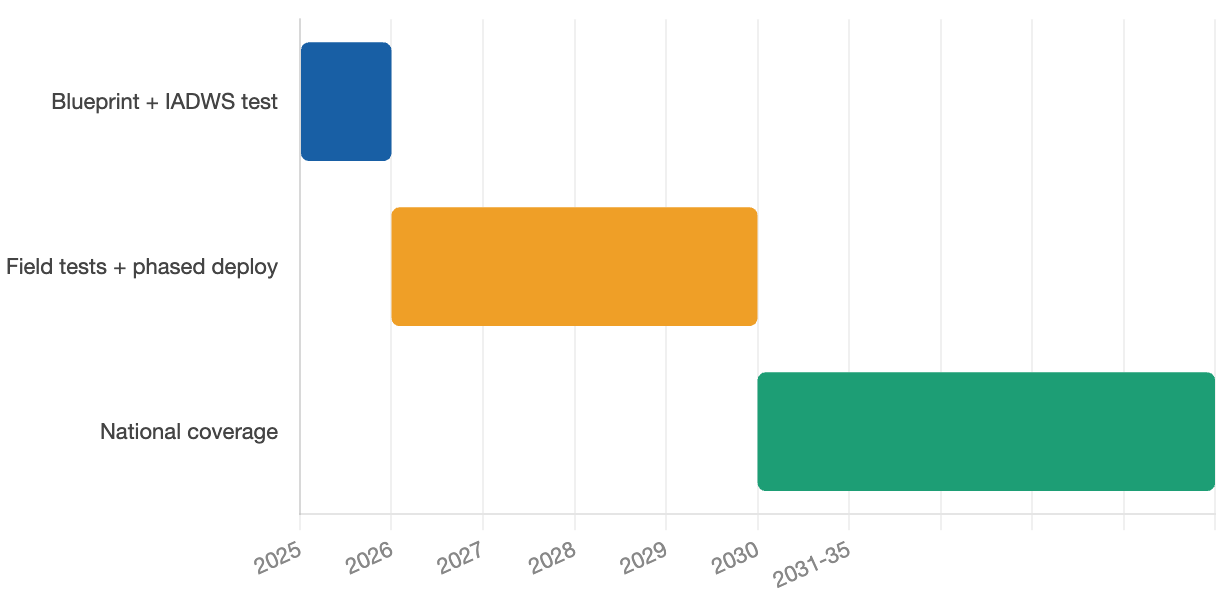
MSC timeline: milestones 2025 to 2035] Timeline showing: 2025-26 blueprint and IADWS test, 2026-30 field tests and phased deployment, 2030-35 comprehensive national coverage. Caption: “MSC deployment timeline — procurement contracts begin flowing from FY27 onward. Source: HSIE Research, DRDO.
Part 4: Who Benefits — The Investment Map
MSC is a decade-long procurement architecture. It does not generate a single large contract award — it generates a sustained, multi-year stream of orders across the companies that build its components.
BEL — The Prime Beneficiary
BEL is the central node of MSC from an investment perspective. As the prime system integrator for radars, command and control, and air defence electronics, BEL participates in every layer of the architecture.
Project Kusha alone is estimated at INR 400 billion for BEL — the largest single item in BEL’s long-term pipeline. The radar network is a separate, phased order stream. The QRSAM electronics contract (INR 300 billion) is the near-term catalyst. The Shatrughat and Samaghat electronic warfare programmes (INR 65 billion combined) are part of the same electromagnetic defence architecture.
BEL’s management has guided that Project Kusha orders will be received by FY29-end. That order, layered on top of the QRSAM award expected in Q1FY27, creates a multi-year orderbook expansion that sustains BEL’s revenue growth trajectory through the early 2030s.
BDL — The Missile Layer
BDL manufactures the kinetic intercept layer of MSC — QRSAM missiles (INR 300 billion programme), VSHORAD missiles (new Amravati facility under construction), and will participate in Project Kusha missile production as the programme scales.
The combined BDL opportunity within MSC is INR 400 billion+ over the programme lifecycle — transformational for a company with FY25 revenues of INR 33.5 billion. The execution challenge remains BDL’s primary risk, but MSC provides the sustained demand pipeline that makes the revenue growth trajectory credible.
Data Patterns and Astra Microwave — The Subsystem Layer
As the radar network scales to 6,000–7,000 units, the demand for radar subsystems — transmit/receive modules, active array antenna units, signal processors, EW components — compounds proportionally.
Data Patterns supplies radar signal processors, EW systems, and COTS modules across multiple MSC-related programmes including the Dharashakti EW programme (INR 50 billion). Astra Microwave supplies T/R modules, AAAU components, and radar electronics — and has been specifically selected alongside BEL as development-cum-production partner for the Virupaksha AESA radar programme that feeds into the MSC sensor layer.
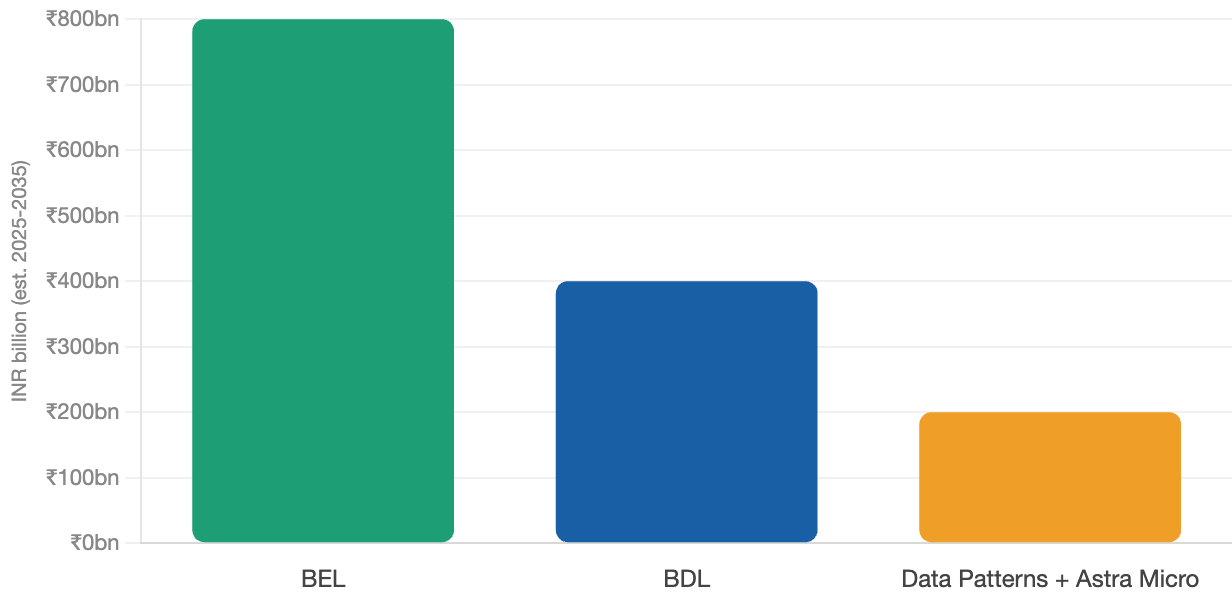
Estimated MSC procurement opportunity by company over 2025-2035. (INR bn)
BEL ~800bn+ (Kusha + QRSAM electronics + radars),
BDL ~400bn+ (QRSAM missiles + VSHORAD + Kusha missiles),
Data Patterns + Astra combined ~200bn (subsystems). Source: HSIE Research, author estimates.
Part 5: What the Market Has and Has Not Priced
The market is aware of QRSAM — it is in BEL’s and BDL’s near-term guidance and broadly expected by Q1FY27.
The market is partially aware of Project Kusha — analysts have modelled it as a future order for BEL but the INR 400 billion quantum is not consistently reflected in consensus estimates.
The market has not priced the full MSC architecture — the radar network, the DEW layer, the satellite ISR integration, and the 10-year sustained procurement stream that these represent. This is not a criticism of sell-side analysts — the programme was announced in August 2025 and the full procurement architecture is still being developed. But it is an observation about where information asymmetry exists.
Investors who understand MSC as a complete architecture — not just its individual components — are positioned ahead of the consensus understanding. As programme milestones advance, procurement contracts are awarded, and the full scale becomes visible in company order books, the market’s understanding will catch up.
That catch-up process is where re-ratings happen.
Next post: My portfolio construction framework for Indian defence — how to size exposure, weight the segments, and manage the risks that could break the thesis.
This series is based on detailed analysis of HSIE’s 286-page institutional defence sector report, March 2026.