We are moving towards the end of this mega “Read the Defence” series. If you haven’t read the earlier editions, have listed below.
Post 1 : India’s Defence Decade Has Begun
Post 2 : The Defence Value Chain
Post 3 : How to Read a Defence Company
Post 4 : The 10 Monitorables: What to Track Every Quarter
Post 5 : HAL: India’s Greatest Order Book
post 6 : Mission Sudarshan Chakra
Moving on to the next post which is about what to track for these businesses in the defence sector. Lets go!
There is a particular dismissal that follows Bharat Electronics Limited in most retail investing conversations.
“It’s a PSU.” “Government company — slow, bureaucratic, no real innovation.” “Trades at a premium only because of policy protection.”
Every part of that dismissal was accurate once.
In the 1960s and 1970s, BEL assembled foreign-designed military equipment under licence agreements with Siemens and other global OEMs. It had no indigenous design capability. Its R&D spend was negligible. Its exports were effectively zero. It was exactly what critics of Indian public sector enterprises describe — a captive, protected assembler with no incentive to do anything differently.
What it is today is something else entirely.
BEL is India’s largest defence electronics company with a 60% domestic market share. It holds 810 intellectual property rights including 288 patents. It employs 2,698 scientists and engineers in a three-tier R&D structure. It generated USD 106.2 million in exports in FY25 — growing at 48% CAGR over three years. It spends 6–8% of revenues on R&D every year — among the highest R&D intensities of any listed defence company in India, DPSU or private.
The transformation from government assembler to technology company is the most underappreciated compounding story in Indian defence equities. This post maps how it happened, what it means financially, and why the next decade looks better than the last.
Part 1: The Three Forces That Transformed BEL
The transformation did not happen because BEL’s management suddenly decided to be more innovative. It happened because three external forces converged and made the status quo untenable.
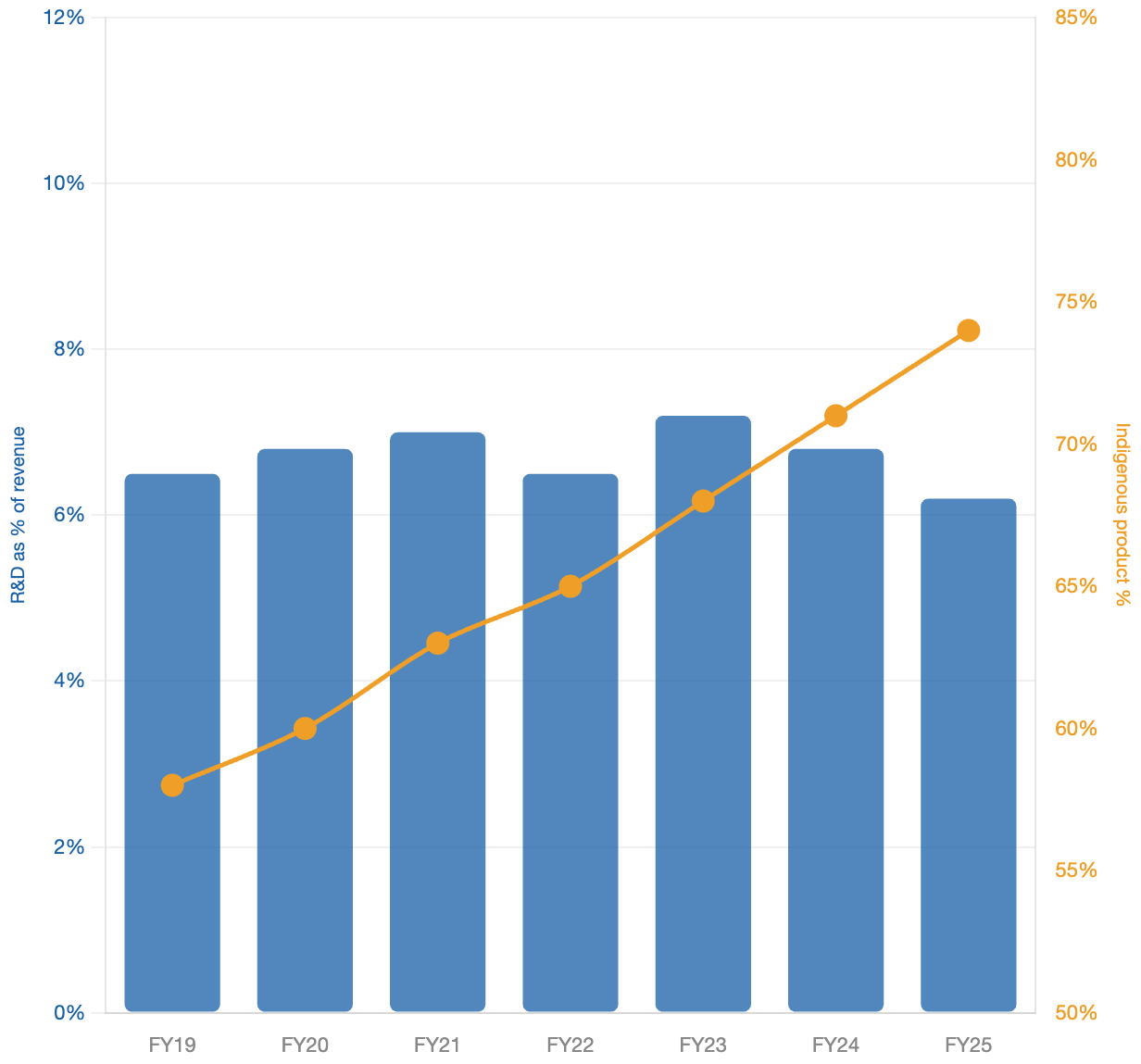
BEL R&D spend and indigenous revenue % over time : BEL’s R&D intensity has been maintained at 6–8% of revenue for seven consecutive years. Indigenous product revenue has risen from ~60% to 74% over the same period.
Force 1 — The Indigenisation Mandate
The government’s import ban — covering 209 weapon categories and 351 subsystems — eliminated BEL’s ability to rely on foreign technology for a growing list of products. When a foreign-origin radar component appeared on the import ban list, BEL had a choice: develop an indigenous equivalent or lose the contract to a domestic competitor that had one.
This created an urgency that decades of policy encouragement had failed to generate. The import ban made indigenous R&D a survival requirement, not a nice-to-have. BEL’s R&D spend stepped up from approximately 4–5% of revenues to 6–8% and has stayed there for seven consecutive years.
Force 2 — DRDO Co-Development
The relationship between BEL and DRDO shifted from vendor-customer to genuine co-development partnership. BEL’s engineers now participate in the early design phases of major defence programmes — not merely in the production phase. The Uttam AESA radar, the QRSAM fire control system, the Project Kusha radar architecture — these are programmes where BEL has contributed engineering capability alongside DRDO’s science capability and owns a share of the resulting technology.
This matters enormously for the business model. A company that only manufactures to someone else’s design is permanently dependent on that design owner for future contracts. A company that co-owns the design has structural incumbency — it cannot be replaced mid-programme without disrupting the technology base.
Force 3 — The Compounding IP Base
BEL has accumulated 810 IPRs including 288 patents and 489 copyrights. In FY25 alone it filed 151 new IPR applications. This is not an accident — it is the output of sustained R&D investment compounding over years.
Each patent represents a product or process that BEL owns outright. Each owned product carries structurally higher margins than an assembled foreign equivalent — because there is no royalty payment, no forex exposure on imported components, and no foreign OEM with pricing leverage. The margin expansion from 21.2% EBITDA in FY20 to 28.8% in FY25 is this IP compounding made visible in the financial statements.
Part 2: The Financial Architecture of the Transformation
Understanding BEL’s financials requires understanding several structural features that are unique to its business model — and that make direct comparison with private sector peers or international companies misleading if done naively.
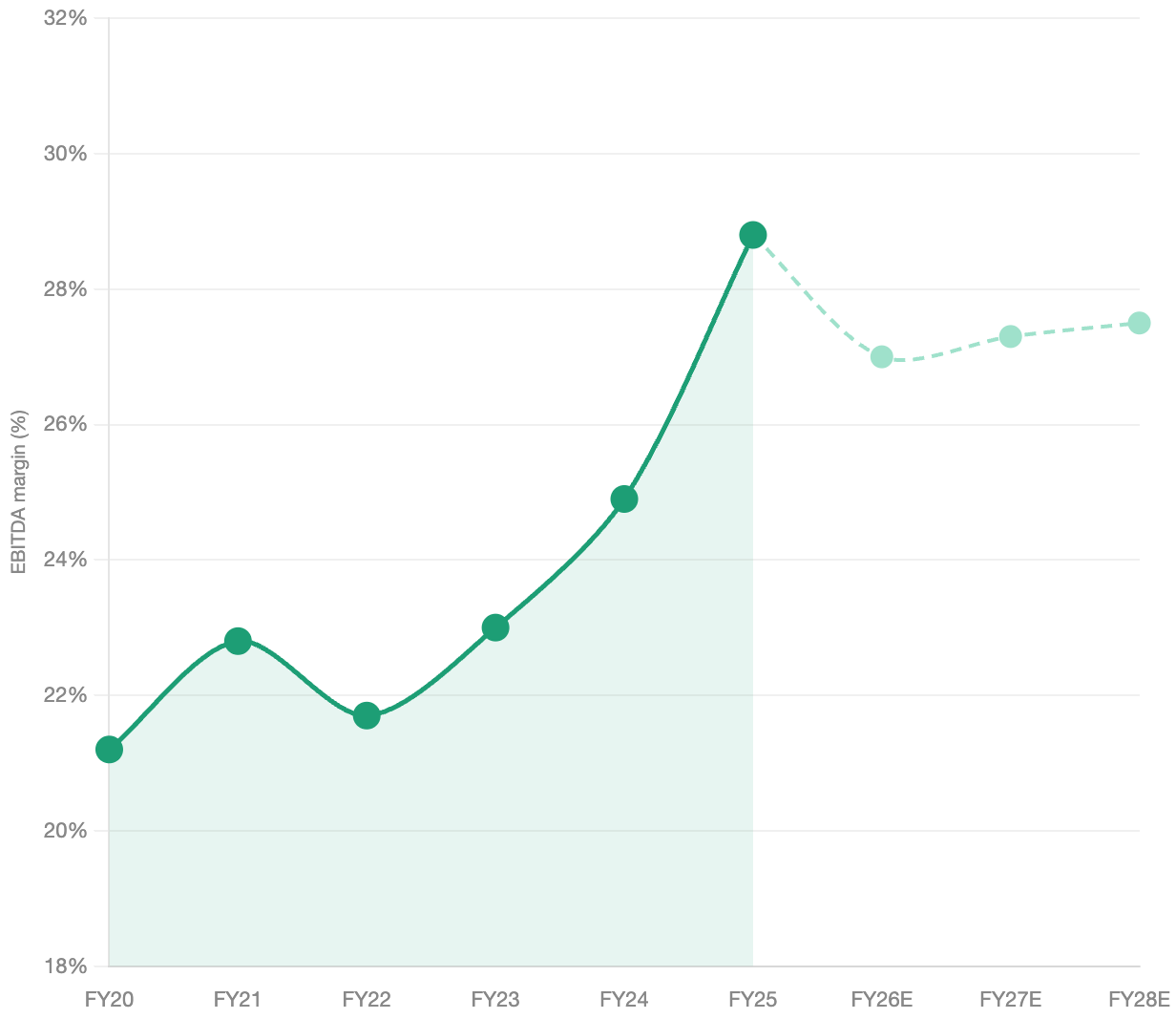
BEL EBITDA margin expansion vs indigenous product % FY20–FY25]:The causal link between indigenisation and margin expansion — BEL’s clearest financial story.
Revenue Quality: The Order Book Mechanics
BEL’s current order backlog is INR 730 billion as of Q3FY26, with a book-to-bill of 3.0x on FY25 revenues. This is the optimal execution zone — enough visibility for 3 years of revenue predictability, efficient enough conversion that the backlog does not signal execution failure.
The composition matters as much as the size. The orderbook is anchored by large platform programmes: LRSAM (INR 45 billion), electronic fuses (INR 40 billion), BMP-2 upgrade (INR 25 billion), Akash Army (INR 20 billion), plus recurring base orders of INR 150–180 billion annually. This base order stream — the annual maintenance contracts, spares, and upgrade packages on deployed systems — provides a revenue floor that is visible, recurring, and grows automatically as the installed base expands.
Margin Architecture: Why BEL Earns More Than It Should
BEL’s EBITDA margin of 28.8% in FY25 is remarkable for a company its size in capital-intensive manufacturing. The explanation has three components.
First, indigenisation. As detailed above — each imported component replaced by an indigenous equivalent removes a cost layer and adds a margin layer.
Second, product mix. BEL’s non-defence products (EVMs, solar systems, EV charging) carry higher margins than some defence products, and their growing contribution lifts the blended margin. The company has guided EBITDA margins of 27%+ going forward — slightly below the FY25 peak due to the ToT cost structure of LRSAM currently in production, but structurally higher than the pre-indigenisation baseline.
Third, operating leverage. With nine manufacturing plants across India and a fixed cost base that scales slowly, incremental revenue from large platform orders flows through to EBITDA at high marginal rates.
The Customer Advance Phenomenon
BEL’s PAT margin of approximately 22% appears high for a manufacturing company. The explanation — covered in Post 3 of this series — is the customer advance structure. BEL holds large advance payments from MoD against contracted programmes. These advances earn interest. That interest flows into “other income” — which grew to 10.5% of PBT in FY25 from 2.8% in FY19.
This is not earnings manipulation. It is a structural feature of how government defence contracts work in India. But investors should track EBITDA margins as the primary profitability measure — PAT margins that include customer advance interest income overstate the underlying operational performance.
Capital Efficiency: The Debt-Free Flywheel
BEL carries zero debt. Its balance sheet is funded entirely by equity and customer advances — making the company effectively self-financing for its working capital cycle. ROE has been in the 25–29% range and ROCE in the 25–28% range through FY24–25. These are exceptional return profiles for a capital-intensive business and they are sustained by the combination of high margins and the absence of interest costs.
Part 3: The Order Pipeline — What the Next Decade Looks Like
BEL’s current orderbook of INR 730 billion is the starting point. The pipeline beyond the existing orderbook is where the decade-long investment case lives.
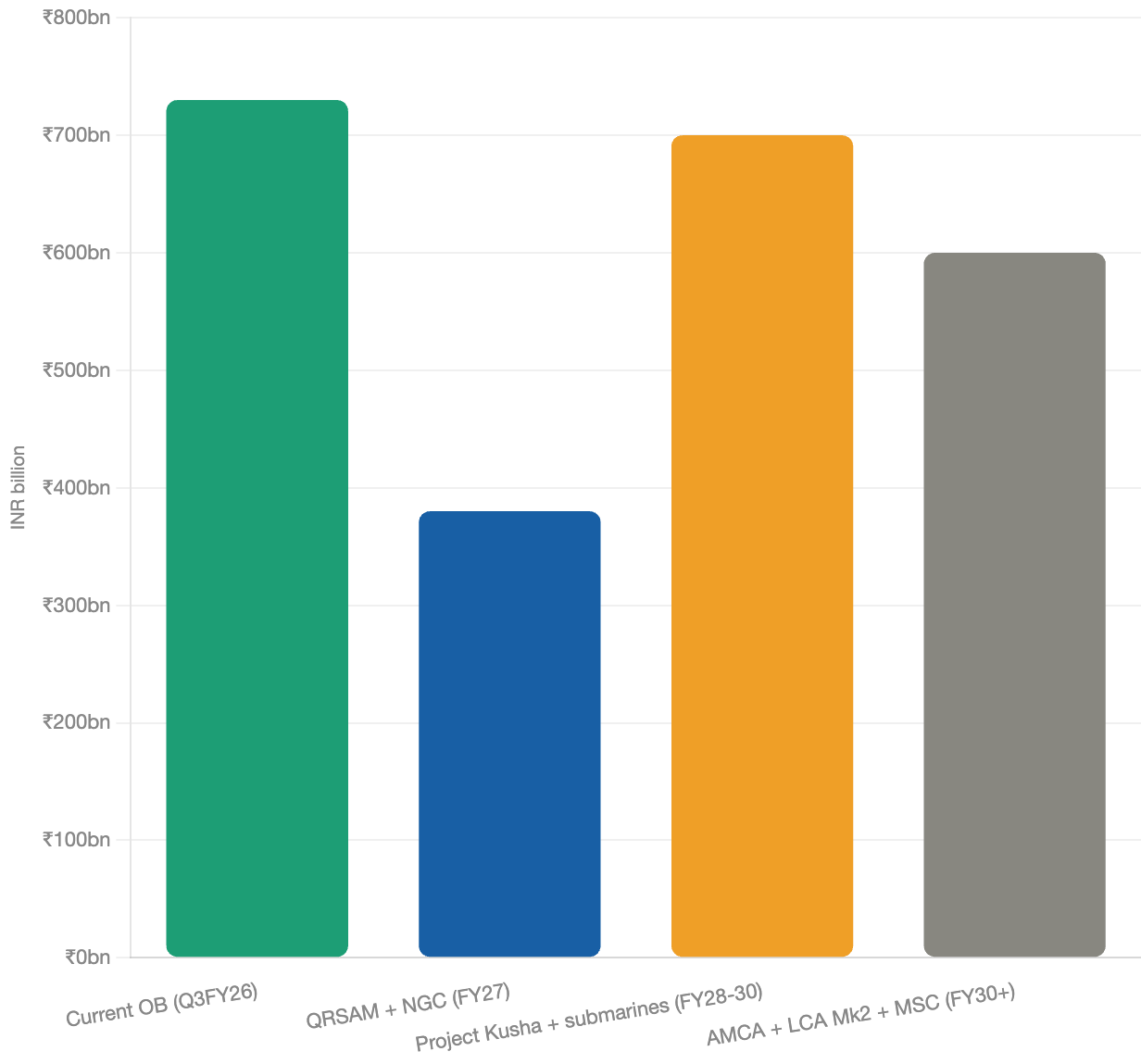
BEL order pipeline: current OB + near + medium + long term : BEL’s order pipeline extends well beyond its current INR 730bn orderbook — the medium and long-term programmes create visibility through the early 2030s.
Near Term (FY27) — The Catalysts
QRSAM electronics integration: INR 300 billion, expected Q1FY27. This is the single most important near-term order for BEL — it adds 40% to the current orderbook in one contract award and triggers a significant re-rating of both book-to-bill and revenue growth expectations.
Next Generation Corvette (NGC) electronics: INR 80–100 billion, expected FY27. BEL is the prime electronics integrator for India’s next generation of naval corvettes. This order follows naturally from BEL’s existing track record on the P-15B destroyer programme.
Avionics package for 97 additional LCA Tejas MK1A: INR 24 billion (already received in Q3FY26 per management). Five-year supply of 20 varieties of airborne electronic systems.
Medium Term (FY28–30) — The Compounders
Project Kusha: INR 400 billion, expected by end-FY29. BEL is positioned as the prime industry integrator for radar, C2, and launcher electronics for India’s indigenous long-range surface-to-air missile programme. This single order, when received, will be BEL’s largest-ever programme by value.
MRSAM and Akash NG upgrades: ongoing multi-year programmes as the deployed fleet requires capability upgrades and life extensions.
P-75 and P-75(I) submarine electronics: BEL supplies electronic warfare suites, weapon control systems, software-defined radios, and sonar systems for India’s submarine programmes. The P-75(I) commercial negotiations currently underway will generate a multi-year electronics supply contract.
Shatrughat and Samaghat EW systems: INR 65 billion combined — strategic electronic warfare programmes for the Indian Army’s ground forces.
Long Term (FY30+) — The Multi-Decade Platform
AMCA avionics and electronic systems. LCA Tejas Mk2 electronics package. Mission Sudarshan Chakra radar network (6,000–7,000 radars over a decade). P-15C destroyers. LPD electronics.
The combined medium and long-term pipeline represents over INR 800 billion in additional orderbook potential beyond the current INR 730 billion backlog — providing revenue visibility that extends through the early 2030s.
Part 4: The New Businesses — The Options Most Investors Haven’t Priced
The strategic optionality in BEL’s new business lines is almost entirely unpriced in current valuations. Each is small today. Each addresses a market that is large and growing.
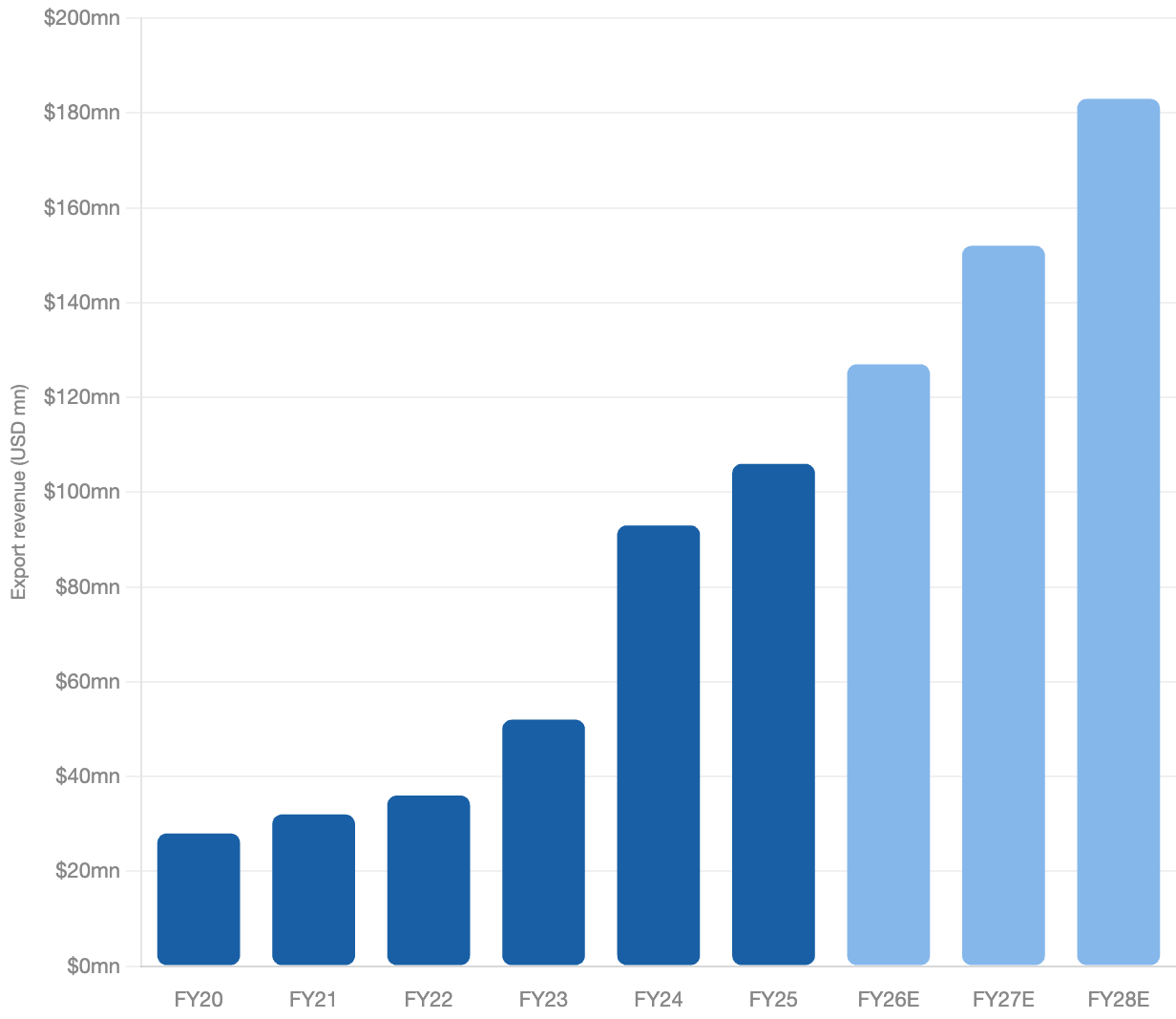
BEL export revenue growth FY22–FY28E] : “BEL exports grew at 48% CAGR during FY22–25. Management targets 20% CAGR going forward, growing export contribution from 4–5% to 10% of revenue.
Unmanned Systems
BEL has operationalised a dedicated UAV business unit in Bengaluru. Current programmes include drone guard systems (counter-UAV), solar-powered unmanned surface vessels (USVs), and high-endurance autonomous underwater vehicles (HEAUVs). The global UAV market is projected to reach USD 126 billion by 2032. BEL’s current UAV revenues are negligible — but the capability foundation is being built.
Space Electronics
BEL is an ISRO-qualified Assembly, Integration, and Testing partner — a status that few Indian companies hold and that provides structural access to India’s growing space programme. The company is transitioning from ground-segment hardware (which it has supplied to ISRO for decades) toward space-based assets including small satellites and LEO constellation components. The Indian space sector is undergoing structural liberalisation — IN-SPACe and NSIL reforms have opened private participation, and BEL is positioned to be a primary beneficiary.
Energy Storage
BEL is developing lithium iron phosphate (LFP) cells for niche defence applications — initially for AUVs, torpedoes, and armoured fighting vehicles. The global LFP battery market is projected to reach USD 124 billion by 2032. BEL’s entry is defence-focused initially but the manufacturing capability, once established, is transferable to civilian applications.
Medical Electronics
Leveraging its precision manufacturing capabilities, BEL is developing hemodialysis machines, turbine-based ventilators, and ICU monitoring systems — initially for government hospital procurement. India’s healthcare electronics import dependence mirrors its defence electronics situation a decade ago. The same indigenisation dynamic that created BEL’s defence margin expansion could, in time, play out in healthcare.
Exports
BEL’s export trajectory is the most immediately measurable of its diversification initiatives. USD 106.2 million in FY25, growing at 48% CAGR over three years. Management targets 20% CAGR going forward — growing exports from 4–5% to 10% of total revenue within 3–5 years. BEL has established overseas marketing offices in Vietnam, Oman, and the UAE, and is targeting Tier-1 supplier status with global OEMs including Thales, SAAB, and Elbit Systems.
The EU’s €800 billion rearmament programme is the most significant near-term export opportunity. With 78% of European procurement since 2022 sourced outside the EU, and 63% from the USA alone, India’s cost-competitive defence electronics ecosystem has a genuine opening. BEL’s products — radars, EW systems, coastal surveillance, SDRs — are combat-proven and export-ready.
Part 5: The Investment Case — Honest Assessment
What works in BEL’s favour:
The moat is structural and self-reinforcing. 60% domestic market share in a policy-protected market, combined with the deepest DRDO co-development relationships in the private and PSU ecosystem, creates an incumbency that new entrants cannot replicate without 10–15 years of programme participation. The order pipeline visibility extending through the early 2030s is exceptional for any listed company. The margin expansion trajectory is not complete — the indigenisation of LRSAM, QRSAM production, and Kusha development will add further IP-owned revenue as these programmes mature.
What deserves scrutiny:
The valuation prices in the growth trajectory with limited room for disappointment. BEL’s primary risk is order award timing — if QRSAM slips from Q1FY27 to Q3FY27, the FY27 revenue estimate requires revision and the near-term earnings growth rate decelerates. The government’s ability to reset nominated contract margins is a structural risk — though it has not materialised and seems unlikely given the indigenisation policy priority.
The competitive intensity risk is real but slow-moving. Data Patterns, Astra Microwave, and Apollo Micro are building the electronics capabilities that could, over time, challenge BEL’s dominance in specific product categories. BEL’s R&D intensity and IP base provide a meaningful lead — but the gap is narrowing.
The honest conclusion:
BEL is about owning the central node of India’s defence electronics ecosystem during a decade of structural growth — with QRSAM, Kusha, and the MSC radar network as the order catalysts that drive compounding over the investment horizon.
The transformation from government assembler to technology company took 70 years to happen. The compounding from that transformation is still in its early chapters.
Next post — the series finale: The portfolio framework — what I’d actually do with the money after seven posts of research.
This series is based on detailed analysis of HSIE’s 286-page institutional defence sector report, March 2026.