Good policy does two things: it addresses the symptom and the cause. The RBI’s 2025 gold loan directive addresses the symptom well. Whether it addresses the cause — a structural incentive problem in how lenders compete — is the harder question. And the answer matters enormously for every stakeholder in this market.
We have spent two editions building the case. Part 1 documented the scale: a ₹16.8 lakh crore portfolio that has grown 3.8 times in three years, overtaken personal loans, and expanded aggressively into new geographies and borrower segments. Part 2 documented the tension: beneath that growth are specific borrower cohorts — concentrated wallets, recent defaulters, last-resort pledgers — whose risk profile is dramatically higher than the aggregate suggests.
Part 3 is about what happens next. The RBI has acted. Markets are re-pricing. Borrowers are navigating a changed landscape. Let us work through each of these in turn.

What the RBI Actually Changed
The new directive — RBI Notification DOR.CRE.REC.26/21.01.023/2025-26 — introduces three substantive changes to gold loan regulation. Each one targets a specific vulnerability revealed by the bureau data.
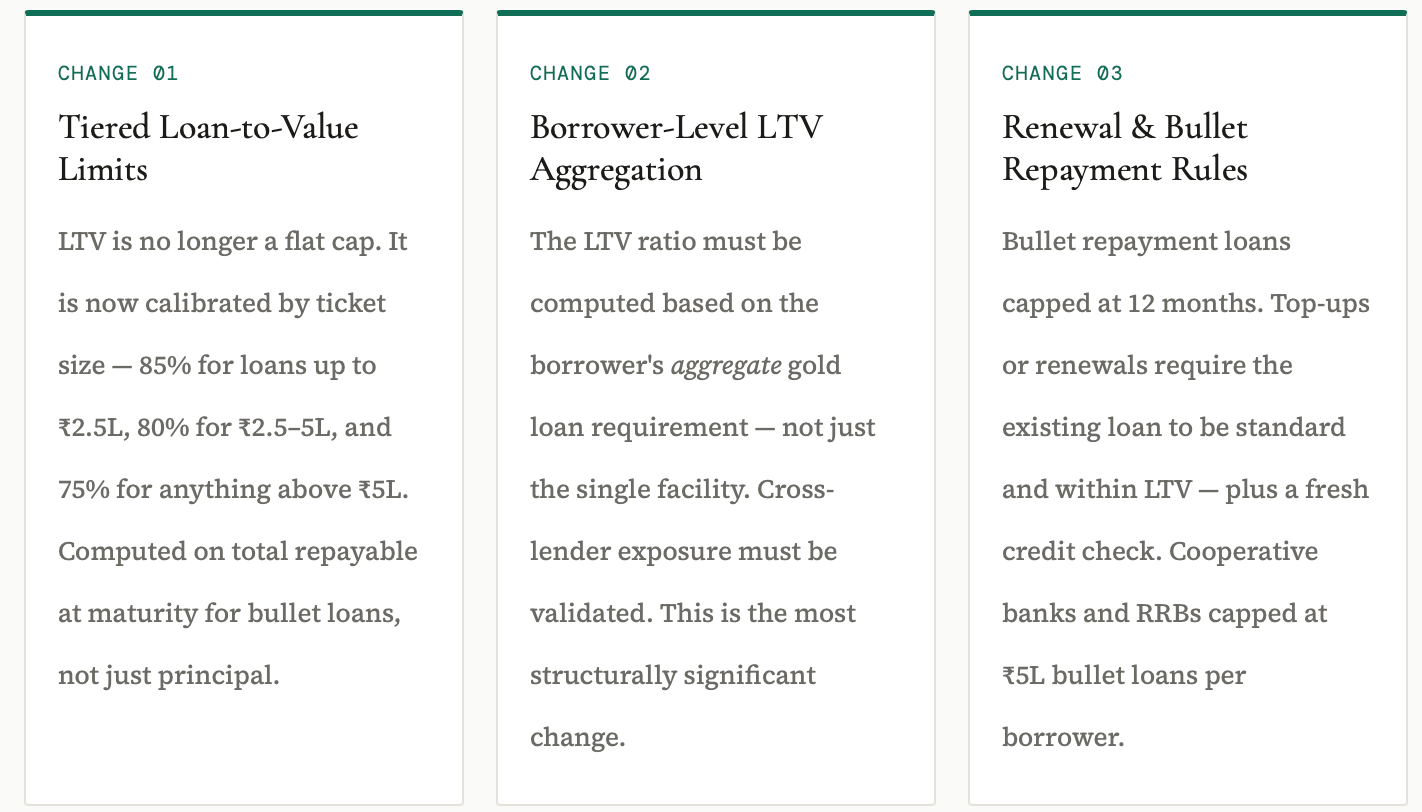
The tiered structure is sensible design. It preserves high LTV access for small borrowers — where the social and inclusion argument for gold loans is strongest — while compressing the headroom for larger loans where the risk data shows the most stress. The ₹2.5L threshold aligns almost precisely with the key risk boundary in the CIBIL data.
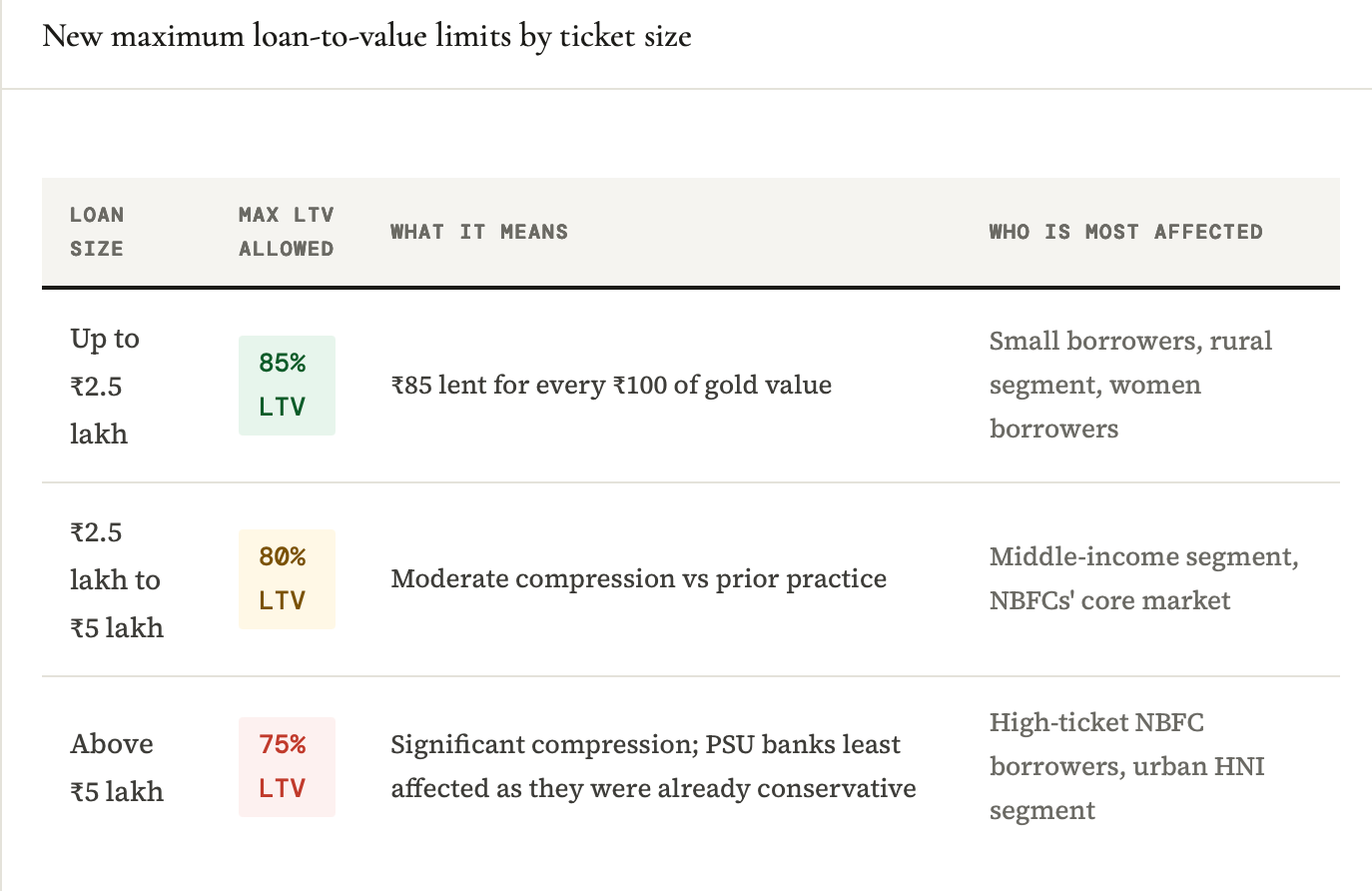
But the more consequential change is the borrower-level LTV aggregation mandate. Previously, each lender computed LTV on their own facility in isolation. A borrower with ₹3L at Muthoot, ₹2.5L at a PSU bank, and ₹1.5L at a cooperative — each lender would apply their LTV to their own loan independently. The aggregate exposure of ₹7L was invisible to each individual lender.
The new directive requires that LTV be computed on the borrower’s total gold loan requirement. In practice, this means lenders must pull bureau data and validate cross-lender gold exposure before originating. The average gold loan accounts per borrower has already moved from 2.3 to 2.9 — meaning a non-trivial share of borrowers have loans at multiple institutions simultaneously. For those borrowers, the effective LTV the new framework targets is the blended cross-lender ratio, not the single-facility ratio.
WHY THIS IS THE MOST IMPORTANT CHANGE
The single-facility LTV model gave lenders a blind spot. They could each feel secured while the system as a whole was over-leveraged against the same underlying collateral — the same gold, pledged to different institutions simultaneously. Some borrowers may have been pledging the same ornaments to multiple lenders across geographies where physical verification was limited. Borrower-level aggregation closes this blind spot. If implemented rigorously, it is the single most powerful risk management improvement in the directive.
The word “if” is doing significant work in that sentence. Bureau integration at the point of origination, for every gold loan, across every lender type including cooperative banks and RRBs, is an operational challenge that will take time to standardise.
Does the Policy Fix the Actual Problem?
The policy fixes the collateral-side problem well. Tiered LTV, borrower-level aggregation, and the bullet repayment cap all reduce the risk of collateral being over-leveraged relative to value. That is the structural vulnerability that most concerns regulators — a gold price correction triggering a wave of under-collateralised loans.
What the policy addresses less directly is the borrower-side problem that Post 2 documented — the stressed borrower who is not over-pledging gold relative to its value, but who simply cannot repay regardless of LTV because their income is under stress and their credit wallet is concentrated to the point of fragility.
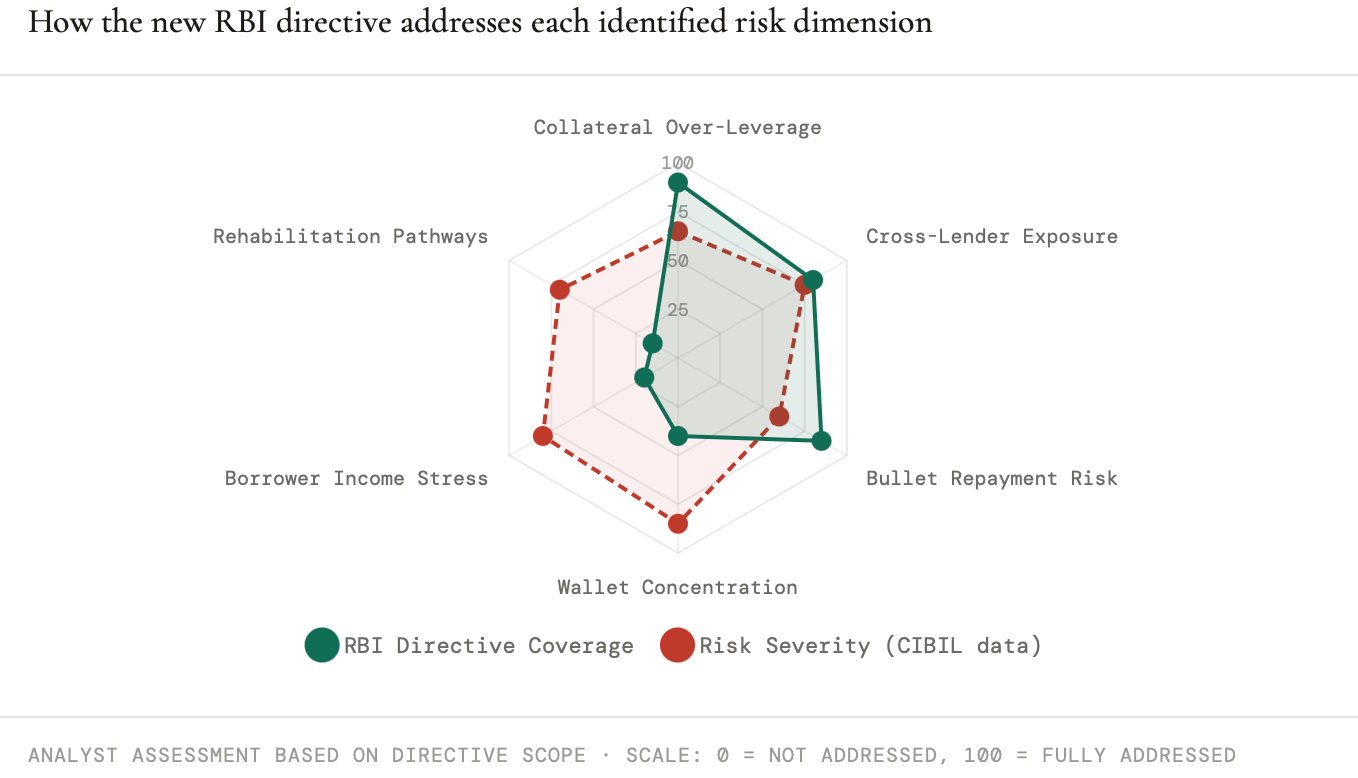
The chart tells the story clearly. The directive is strong on the collateral and structural dimensions — exactly where regulator visibility is highest. It is weak on borrower income stress and rehabilitation pathways — exactly where the most concerning data lives. The 44% exit rate of stressed borrowers, the one-third whose last active product is a gold loan, the 18.8% bad rate in the concentrated-stressed cohort — none of these are directly addressed by LTV caps.
This is not a criticism of the directive. Regulators cannot mandate lender compassion, and income-based underwriting for gold loans would fundamentally change the product’s accessibility. The point is simply: the policy makes the system more structurally resilient without resolving the inclusion paradox. Stressed borrowers will still be able to access gold loans. They will just access smaller ones.
THE IMPLEMENTATION RISK
The directive applies to all regulated entities — commercial banks, cooperative banks, RRBs, and NBFCs. The bureau integration requirement is straightforward for large NBFCs and banks with existing CIBIL connectivity. It is considerably harder for the 1,500+ cooperative banks and regional rural banks in the gold loan ecosystem, many of whom do not have real-time bureau pull at origination.
Regulatory intent and operational reality have a gap in Indian financial services. The test of this directive will be in the compliance rate among smaller lenders — and in whether RBI supervisory bandwidth is sufficient to verify it.
The Investor Lens: Reading Gold Loan Stocks Through This Framework
For equity investors — particularly those holding or tracking Muthoot Finance, Manappuram Finance, IIFL Finance, or the PSU banks with significant gold loan books — the question is what this regulatory shift means for earnings, growth, and risk profile going into FY27 and beyond.
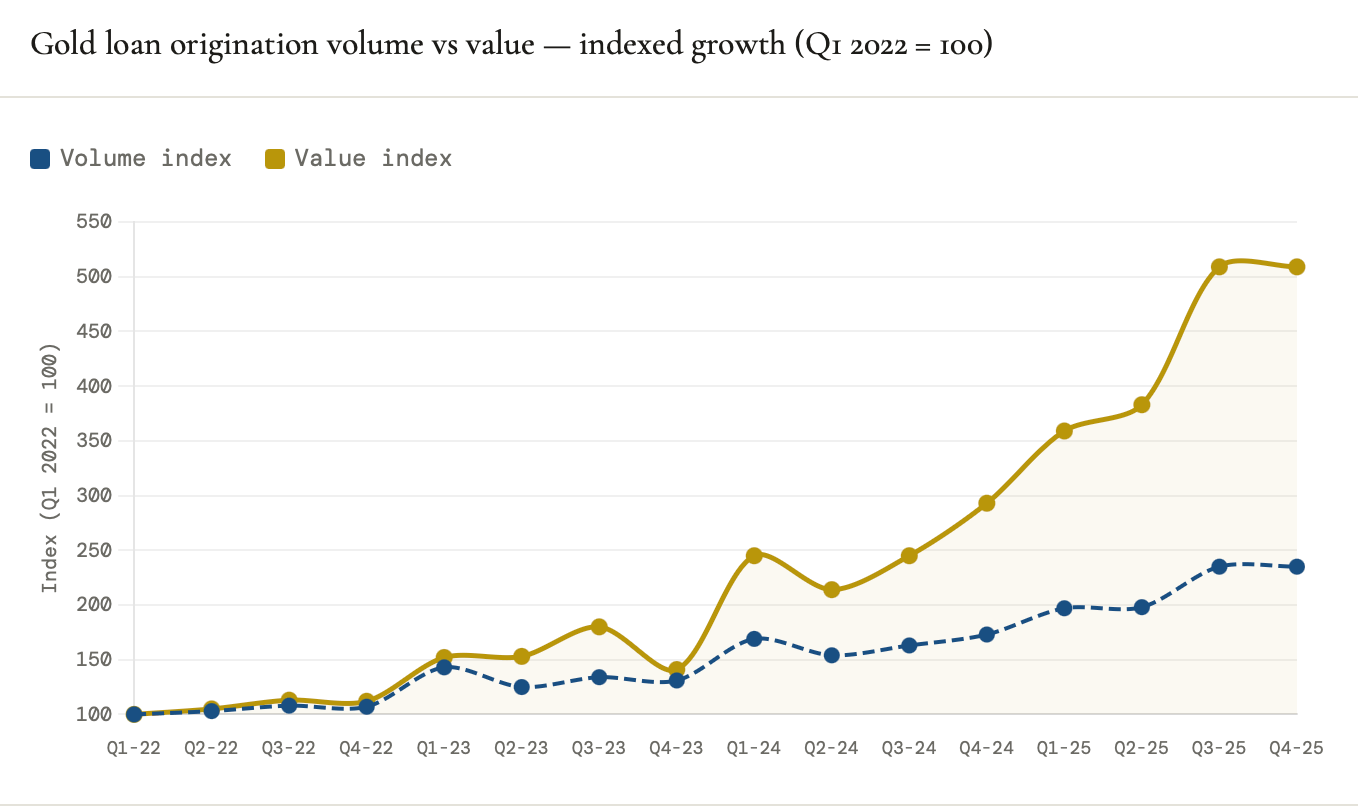
The volume-value gap is the key chart for investors. Origination volumes grew 2.3 times. Origination values grew 5.1 times. The difference — ticket size inflation — was fuelled by two things: rising gold prices increasing collateral values, and NBFCs competing on higher LTV to capture market share.
The RBI directive directly compresses the second driver. Higher LTV originations for large-ticket loans are now capped more tightly. If gold prices plateau or correct even modestly, the first driver weakens too. The ticket-size inflation that drove value growth ahead of volume growth is structurally constrained going forward. This is the single most important earnings headwind for NBFC gold loan franchises in FY27.
Three specific metrics are worth tracking in H1 FY27 quarterly results for gold loan lenders.
First, origination value vs volume divergence — if the gap narrows (volumes hold but value growth slows), the ticket-size tailwind is fading.
Second, AUM yield — if lenders are forced to lower LTV, they are lending less against the same collateral, which compresses AUM growth even if volumes hold.
Third, Stage 2 and Stage 3 trends in the ₹50K–₹2L segment — where the CIBIL data flags early stress signals that are not yet visible in the headline NPA numbers.
Bringing the Three Parts Together
This series set out to tell the complete gold loan story — not the headline version, and not the alarmist version, but the version that the bureau data actually supports when you read it carefully.
The headline version is: gold loans are booming, quality is improving, financial inclusion is expanding. All of that is true. The 3.8x growth is real. The Prime+ share rising from 43% to 52% is real. The North India expansion is real. These are genuine structural achievements.
The complete version adds: beneath that growth, specific borrower behaviours predict failure at 9x the average rate. The stressed borrower cohort is using gold as a final exit from formal credit — and then exiting anyway. The competitive dynamics of gold loan NBFCs created LTV practices that concentrated systemic risk in ways the aggregate data obscured. The RBI has moved to address the structural vulnerabilities. The borrower-side vulnerabilities remain.
What this series does not conclude is that a crisis is imminent or inevitable. India’s gold loan market is genuinely different from, say, the MFI crisis of 2010 — the collateral is real, liquid, and internationally valued. A stressed borrower who cannot repay loses their gold. The lender recovers. The system does not collapse the way an unsecured MFI book does when multiple borrowers simultaneously default. The risk is real but bounded.
What it does conclude is that growth without rigorous borrower-level assessment is building a tail risk that looks benign in aggregate and problematic in cohort. Every credit professional who has lived through a cycle knows that tails are where cycles end. The data is telling us to watch the tail carefully.