The 2025 Union Budget made one subtle yet powerful shift for investors: Short-Term Capital Gains (STCG) tax rose from 15% to 20%, and Long-Term Capital Gains (LTCG) from 10% to 12.5%.
On the surface, this might feel like just another tweak in tax slabs. But for investors running high-churn strategies like Momentum investing—especially via Smallcases or direct stock PMS portfolios—the impact is much deeper.
Momentum and the Tax Trap
Momentum strategies, by design, involve frequent rebalancing. Stocks are bought and sold as price and trend signals change—meaning most gains qualify as short-term capital gains. With the STCG rate now at 20%, you’re giving away a large slice of your returns to taxes every year.
Contrast this with a Momentum Mutual Fund. Here’s the critical edge:
Mutual Funds don’t pay capital gains tax on churn inside the fund.
Taxes apply only when you redeem your units, and even then, you’re taxed as LTCG (12.5%) if held for more than a year.
In effect, you’re deferring taxation and compounding pre-tax returns, letting the snowball grow much larger before the taxman takes his cut.
The Numbers Speak
A recent illustration (see table ) highlights the gap:
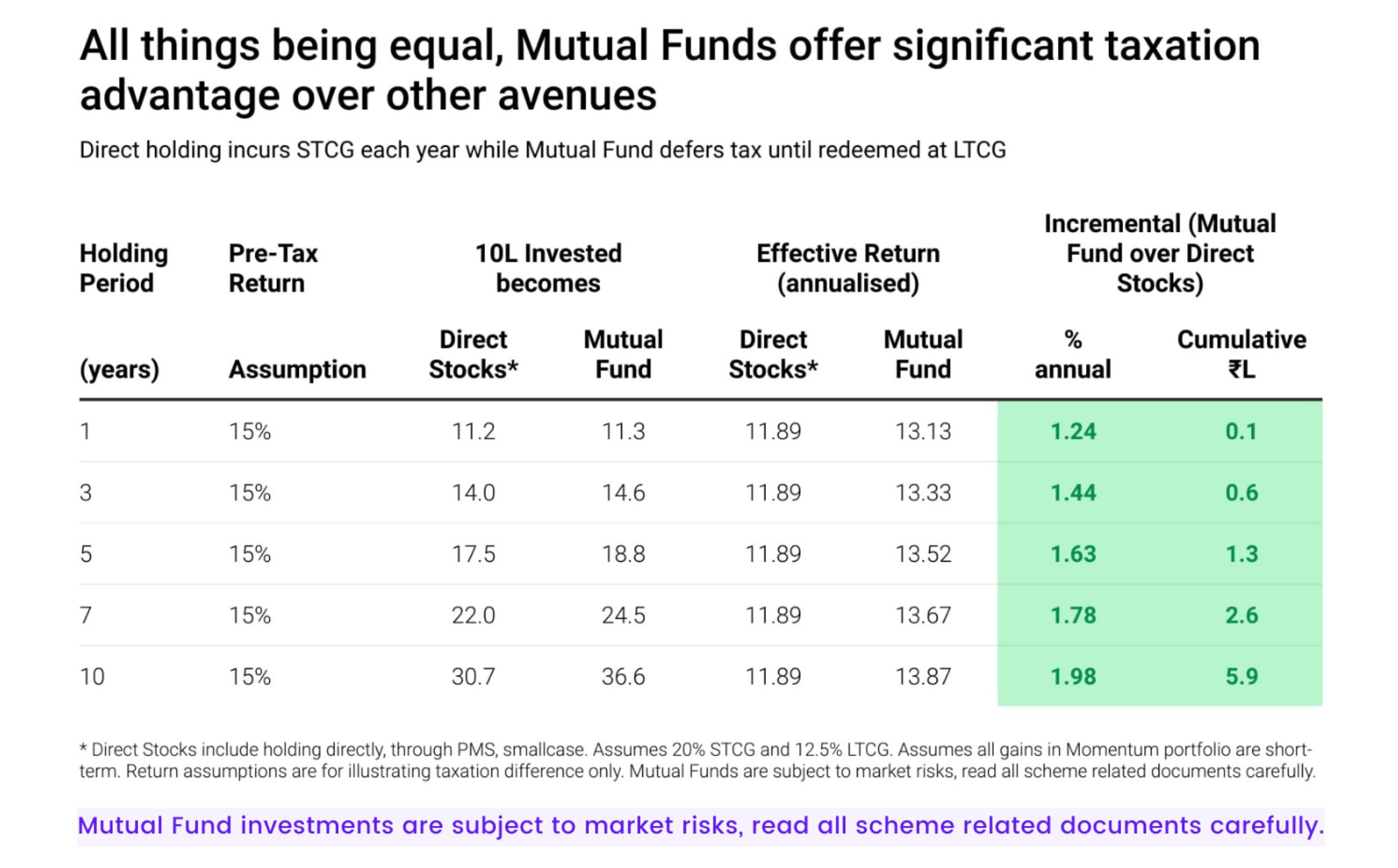
Over 10 years, ₹10 lakh invested in direct stocks under a momentum approach grows to ~₹30.7 lakh post-tax.
The same ₹10 lakh, if invested in a Momentum Mutual Fund, grows to ~₹36.6 lakh post-tax.
That’s a ₹5.9 lakh difference—purely due to tax efficiency.
The effective annualised return difference works out to ~2% every year. Over a multi-year horizon, this gap isn’t just incremental—it’s transformational.
Why This Matters Beyond Taxes
Behavioral Advantage – Mutual Funds reduce the temptation to book gains too early, since churn happens inside the fund. Investors stay disciplined.
Operational Simplicity – No need to track tax lots, file complex returns, or worry about STCG vs LTCG classifications for each stock transaction.
Compounding Edge – Deferring taxes is essentially like getting an “interest-free loan” from the government, which compounds in your favour.
Recommendation: Evolving from Smallcase to Fund
For investors currently holding Momentum Smallcases, the data points to a clear recommendation:
Transition into any Momentum-based Flexi Cap Fund. (CapitalMind has come up with something similar)
You retain the underlying strategy (momentum factor exposure).
But you gain the structural advantage of tax deferral, operational ease, and superior long-term compounding.
This is not about abandoning Momentum. It’s about executing it in the most tax-aware, compounding-friendly wrapper.
Final Takeaway
The Budget 2025 tax changes have made being “tax-smart” more important than ever. For strategies with high churn like Momentum, the case for housing them inside Mutual Funds rather than Smallcases is stronger than ever.
💡 Think of it this way: If the edge of a momentum strategy is 3–4% alpha, why give away half of it to the taxman? Structure matters as much as strategy.
How to read this
Holding Period (years): This is the length of time you hold your investment, from 1 year to 10 years.
Pre-Tax Return Assumption: Both investments are assumed to grow at the same rate of 15% per year before any taxes are deducted.
10L Invested becomes: This shows how much your initial ₹10 lakh investment would grow to.
Direct Stocks: The value is lower than the mutual fund because taxes are applied each year on short-term gains (STCG). The table assumes a 20% STCG tax rate.
Mutual Fund: The value is higher because the table assumes taxes are deferred, or put off, until you sell the fund. The gains within the fund grow tax-free until that point. This is the core tax advantage.
Effective Return (annualised): This is the actual yearly return you get after taxes.
Direct Stocks: The return is consistently lower (11.89%) because taxes are paid annually.
Mutual Fund: The return is higher and increases with the holding period (from 13.13% to 13.87%) because the tax is deferred, allowing more of your money to compound over time. The longer you hold it, the more effective this deferral becomes.
Incremental (Mutual Fund over Direct Stocks): This column highlights the benefit of investing in a mutual fund instead of direct stocks.
% annual: This is the difference in the effective annual return. For example, after 10 years, the mutual fund's effective return is almost 2 percentage points higher than the direct stocks.
Cumulative ₹L: This is the total extra money you would have with the mutual fund investment. After 10 years, you would have ₹5.9 lakh more with the mutual fund due to the tax advantage.