So I read a tweet by one of my favourite Fund Managers CEO Radhika Gupta where she announced India’s first REIT oriented mutual fund and it felt so interesting to go through the details.
Often a rule changes, and a new way of investing opens up. On the 1st Jan 2026, India’s market regulator did something technical: it re-labelled REITs as “equity.” 6 months later, on the 1st July, those REITs were allowed into equity indices for the first time. And the day that door opened, Edelweiss walked through it with the first passive fund built on the back of it.
The Edelweiss Nifty REITs & Realty Index Fund would be open for subscription (5–19 Aug’26). It’s the first mutual fund in India to package listed REITs and listed real-estate developers together in a single, low-ticket index fund. And it’s worth understanding properly not as a tip, but as a new building block you can decide whether to use or ignore.
In the next ten minutes: I will explain what it actually is, show you where the returns come from, and then try to help you come to a decision. By the end you’ll be able to size it , or skip it , for the right reasons.
The best time to understand a new instrument is before everyone owns it. A rule changed; a product appeared. Your edge is reading it clearly while it’s still new.
First — what is a REIT, really?
A landlord you can buy on the exchange
A REIT takes rent-yielding Grade-A buildings, office parks and malls, and pools them into a single trust whose units trade on the exchange. Buy a unit and you own a sliver of every building in it. By law the trust must hand you at least 90% of its distributable cash. Now picture the usual alternative: one flat, one city, a home loan, and a lifetime of tenant calls. Here you get a diversified slice of the country’s best commercial property instead. Liquid. Professionally run. Paying you rent every quarter.
Six of these trade in India today. Between them they hold about ₹3.1 lakh crore of property at 90–99% occupancy. Remember that number. It’s the raw material the whole fund is built on.
But the fund doesn’t only buy REITs. It tracks an index that mixes them with listed developers, the Nifty REITs & Realty Total Return Index. And that mix is the first thing to look at closely, because it isn’t quite what the name suggests.
What you’re actually buying: a 60/40 split
Fifteen names. The rulebook forces at least 60% into REITs and hands the rest to the biggest developers. Right now that shakes out to roughly 60% REITs and 40% realty stocks. Here’s the whole basket, ranked:
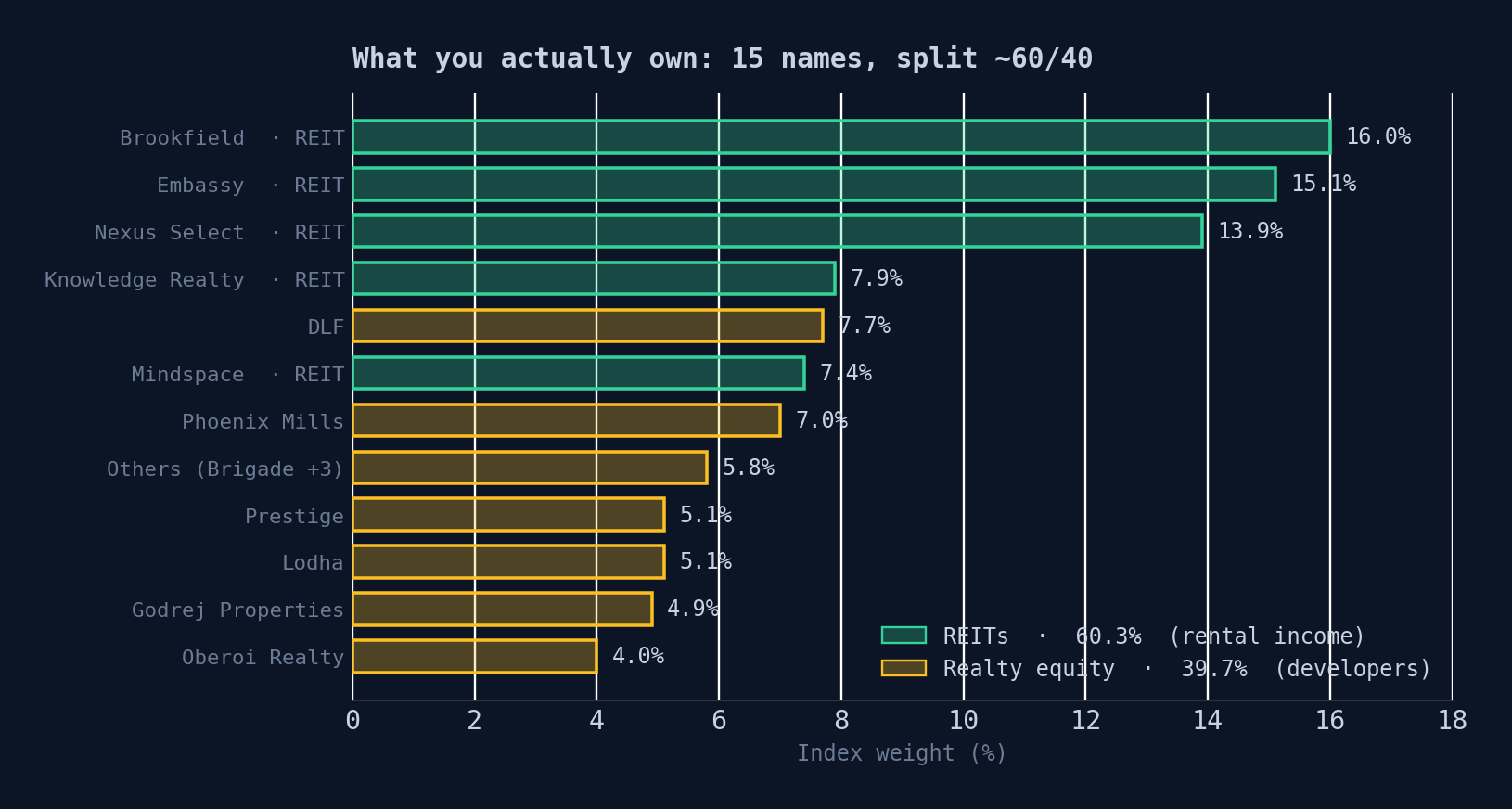
It’s probably being marketed as a REIT product, but ~40% of it is developer equity — DLF, Godrej Properties, Lodha, Phoenix Mills, Prestige, Oberoi. Those aren’t quiet, rent-collecting landlords. They’re cyclical, high-beta growth stocks that swing positively with the property cycle and the mood of the market. With only 5 REITs listed, it might turn out to be a good move to add Real Estate stocks. Also note that the InvITs as a category are still categorised as hybrid and probably because of that Edelweiss team would have not included InvITs.
Reframe #1 — the 40% you might not notice
Read this as a real-estate equity fund with an income cushion, not an income fund with a bit of equity spice. That single reframe changes how you size it and what you expect from it.
These are real buildings, throwing off real cash
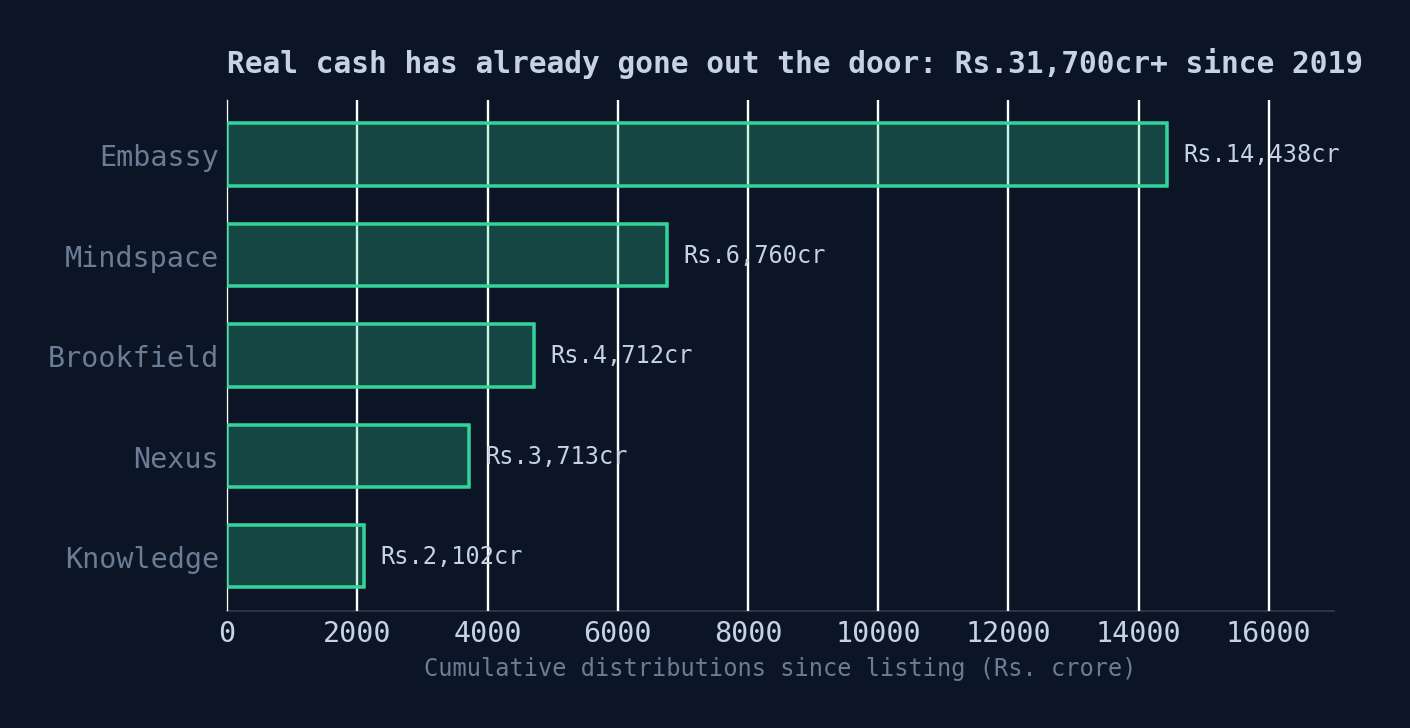
Before we get to the risks, let’s be fair about what’s underneath. The 5 REITs have distributed over ₹31,700 crore to unitholders since 2019 — actual cash, quarter after quarter.
There’s a value angle too. The market prices these six trusts at roughly 32% below the appraised value of the buildings they hold. Part of that is normal; listed vehicles often trade under net asset value. But it’s a real cushion, and it runs wider on some names than others.
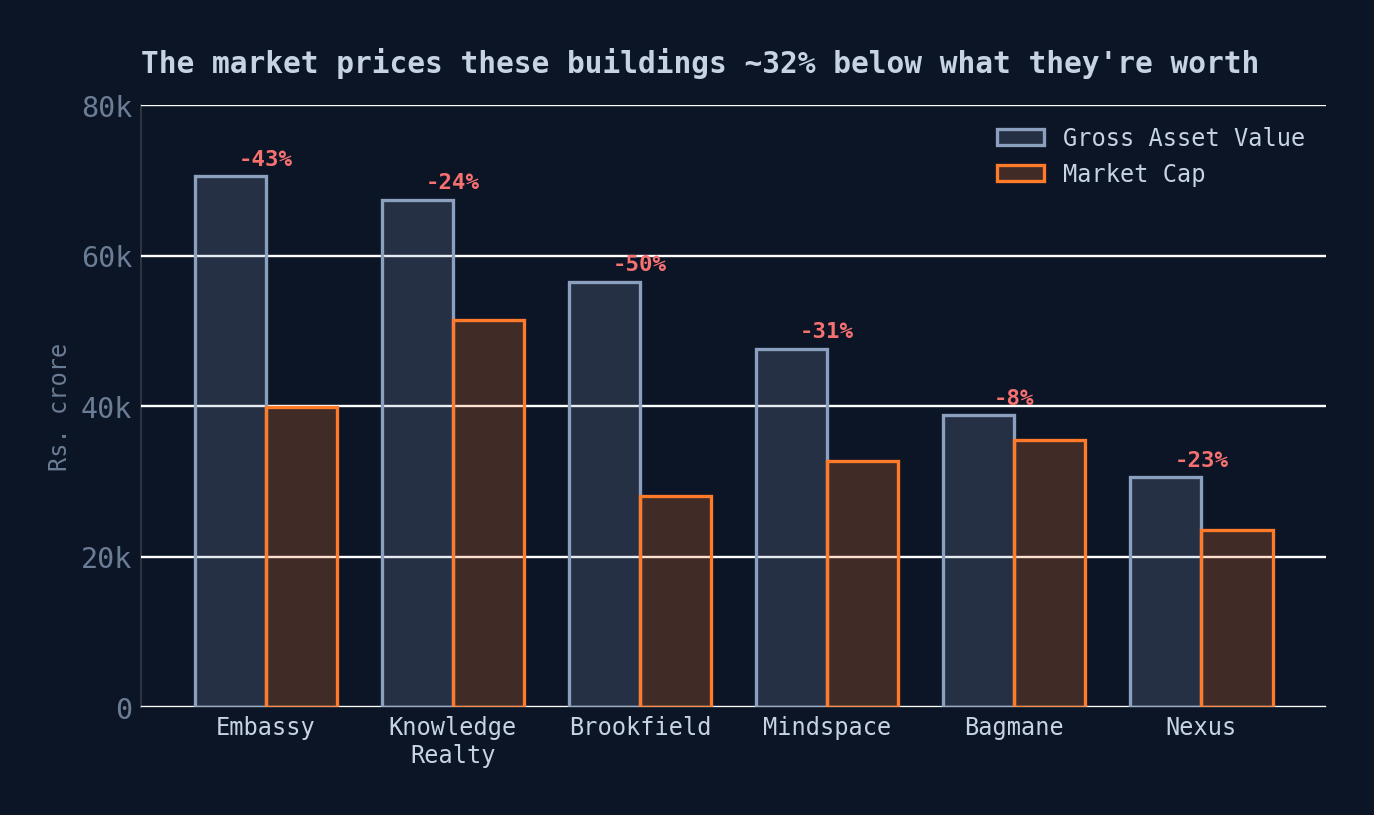
Put it together and the bull case is easy to state. Full buildings, throwing off income, bought below the value of their own bricks, with a long runway ahead: only about 13% of India's Grade-A office stock has been REIT-listed so far. Attractive stuff. Now the harder question. How does the thing actually behave?
Where your return actually comes from
It helps to break the return into three honest pieces. Think of it as:
- rent,
- plus rent growth,
- plus-or-minus what interest rates do to the price.

The first two are calm and predictable. The third is where the drama lives. REIT prices move inversely to interest rates — when rates fall, prices jump; when rates rise, prices go down.
REITs fell hard through 2022–23 as rates climbed, then popped 20–25% in 2025 once rates came back down. In a given year, that single swing can drown out all the quiet rent underneath it.
Which matters right now as the RBI's repo rate sits at 5.25% and the stance is neutral. A big chunk of the recent gain rode falling rates, and there's simply less room left for that tailwind to blow again. So don't draw a straight line from the last two years. The sensible base case is a return nearer to yield-plus-rent-growth than another rate-driven pop.
The real product isn’t yield — it’s a smoother ride
This is where the 60/40 blend earns its keep. It's the best thing about the fund, and it's the easiest to miss. Watch how differently the three parts of this sector have behaved:
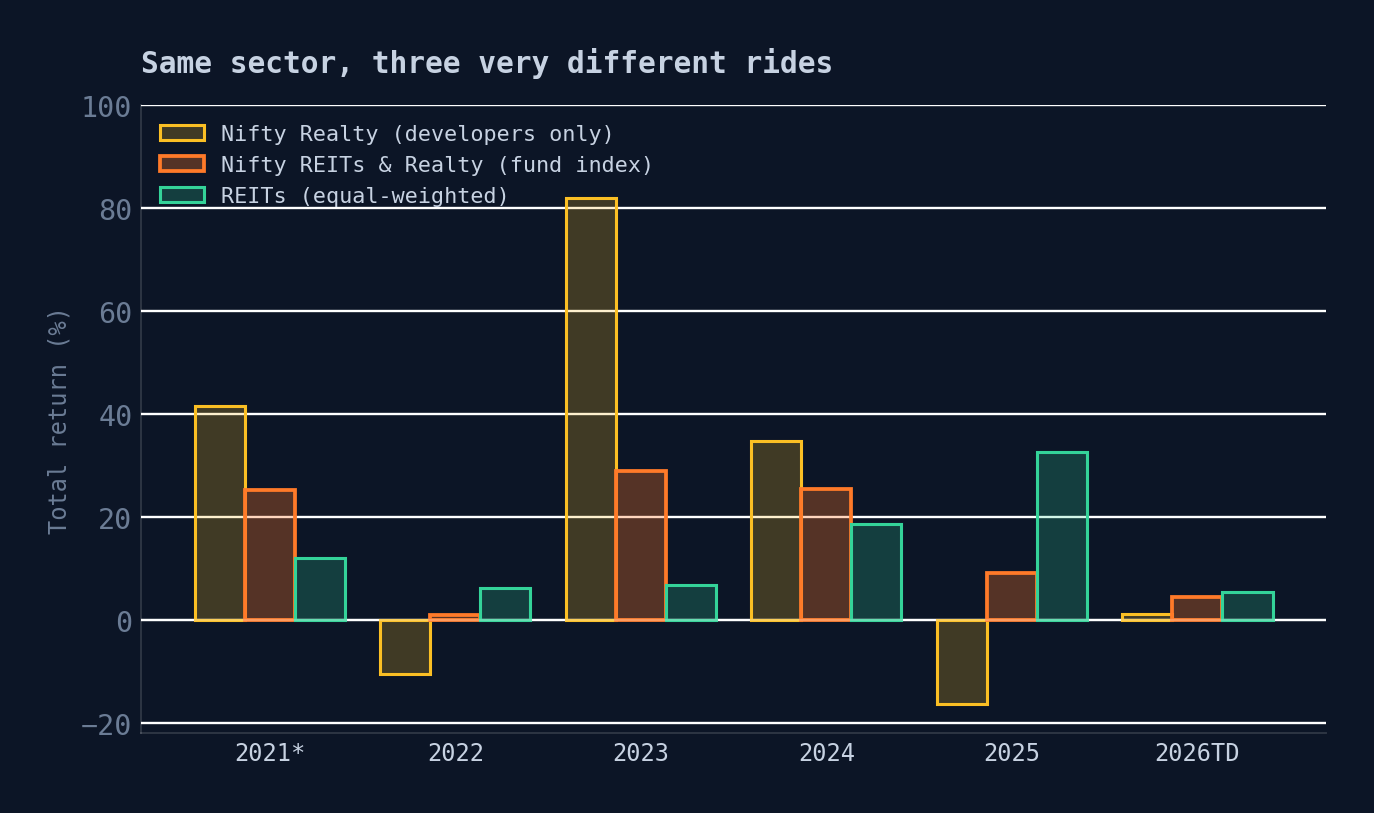
The developer stocks, in amber, are a rollercoaster. Up 82% in 2023. Down 16% in 2025. Pure REITs, in green, are calm to the point of sleepy; they managed just 6.8% in that same barn-burner year. The blended index in orange sits between the two, keeping some of the developers' upside while the steady REITs sand the worst lurches off the ride.
You can see it cleanest in one number — how much the returns bounce around:
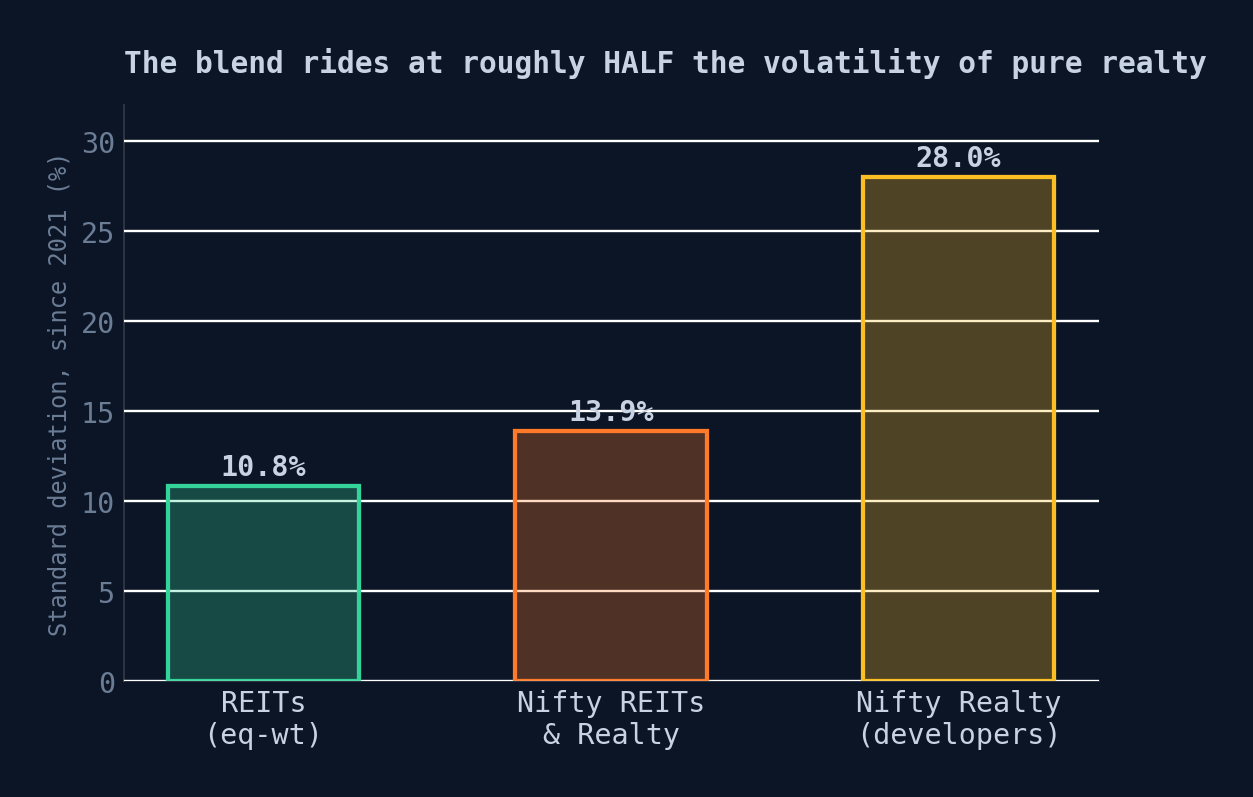
You’re not really buying a high yield here. You’re buying real-estate exposure that swings about half as violently as owning the developers alone. That’s the actual product.
How it stacks up against everything else
Where does a REIT fund fit next to the usual options? The honest scorecard:
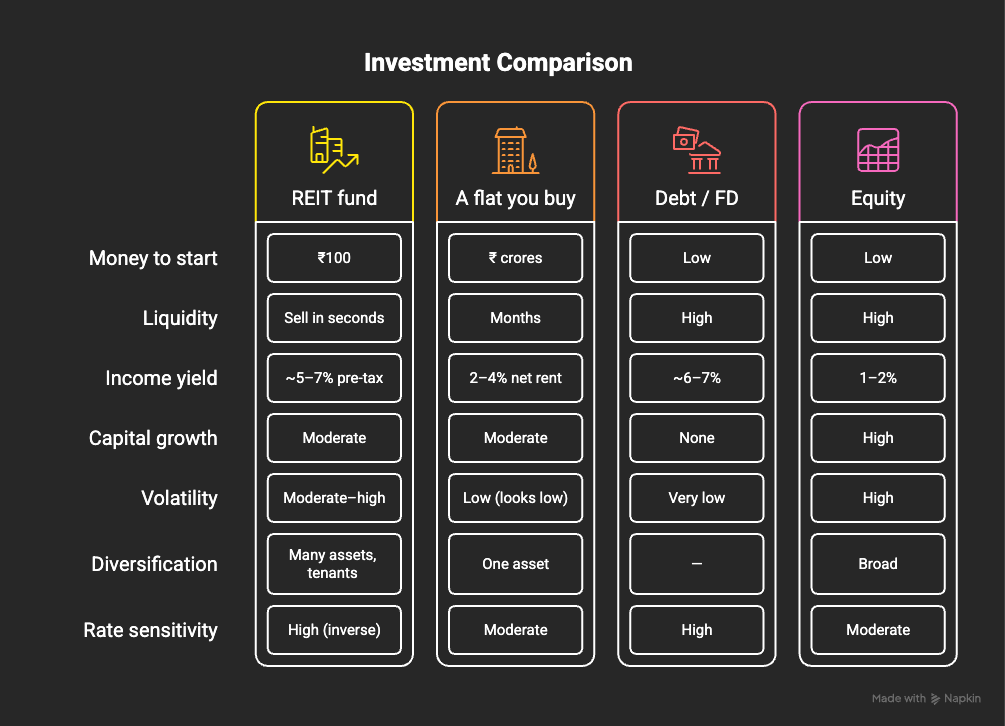
Against buying a flat, it isn't close. ₹100 or crores. Sell in seconds or wait months. A spread of buildings or a single door. A professional manager or your weekends. Against debt, it's a similar yield with growth and some inflation cover stapled on, and you pay for that in volatility and rate sensitivity. So it sits alongside a bond allocation. It doesn't replace one.
The peer check — and a fee you should stare at
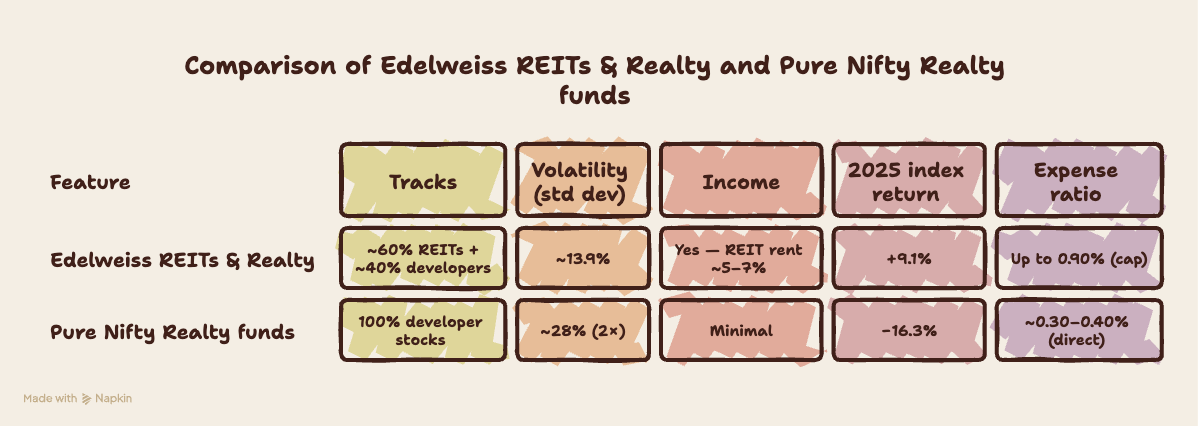
Edelweiss is first to the combined index. But pure Nifty Realty funds already exist, from HDFC, Nippon and Motilal Oswal. The contrast is the entire pitch. It’s also where the second flag is hiding.
Reframe #2 — the 0.90% question
A pure realty index fund charges ~0.35%. This fund’s expense ratio is capped at 0.90% — more than double. Some premium is fair (herding thinly-traded REIT units and quarterly rebalances is harder work), and 0.90% is a cap, not a promise — the direct plan should price lower. But at 0.90%, roughly one-sixth of a 5–6% yield vanishes into fees every year. Watch the actual direct-plan TER at launch. It quietly decides whether the income math works.
The tax angle — real, but oversold
Because REITs count as "equity" now, the fund is taxed like an equity fund. 12.5% long-term capital gains after a 12-month hold, against 24 months for a physical property. That part is a real win. The deck's headline pitch, though, is this picture: 6% inside the fund versus 4.2% holding the REITs yourself.
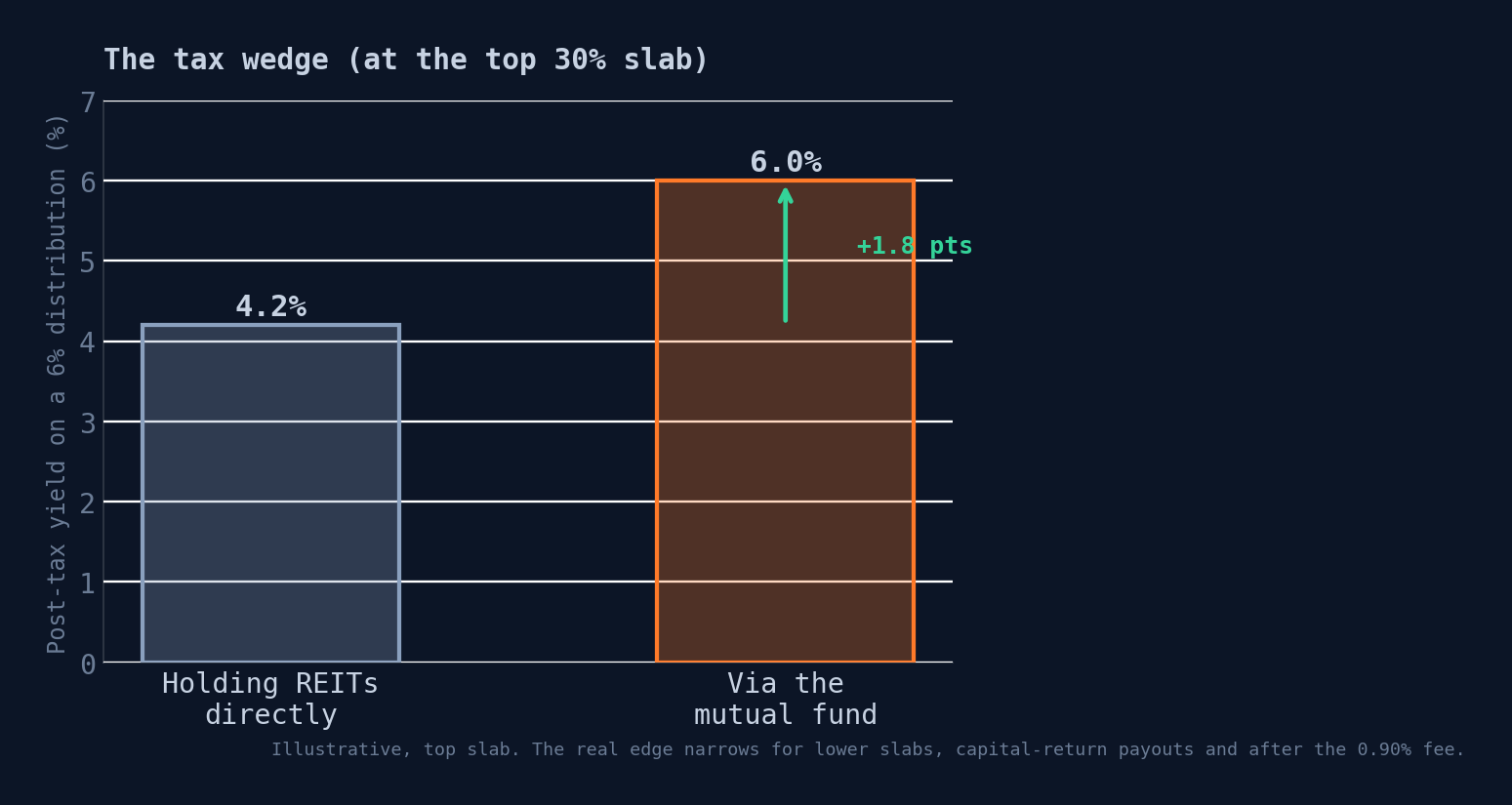
The mechanism is real. But an analyst has to add three caveats the slide leaves out:
Reframe #3 — read the tax pitch critically
One, it’s deferral, not exemption — you still pay 12.5% when you sell; the tax is postponed, not erased.
Two, the full 1.8-point gap assumes the top 30% slab and that every rupee of the payout is taxable income — for lower slabs, or where part of the distribution is a capital return, the direct-holding drag is smaller and the edge shrinks.
Three, the 0.90% fee eats back a chunk of whatever’s left. Still helpful for high-slab investors — just not the clean “6 versus 4.2” the poster promises.
So — should it be in my portfolio?
Here's how I'd hold it in my head. A well-built, genuinely new satellite. Not a core. And not a stand-in for fixed income, whatever the yield tempts you to think.
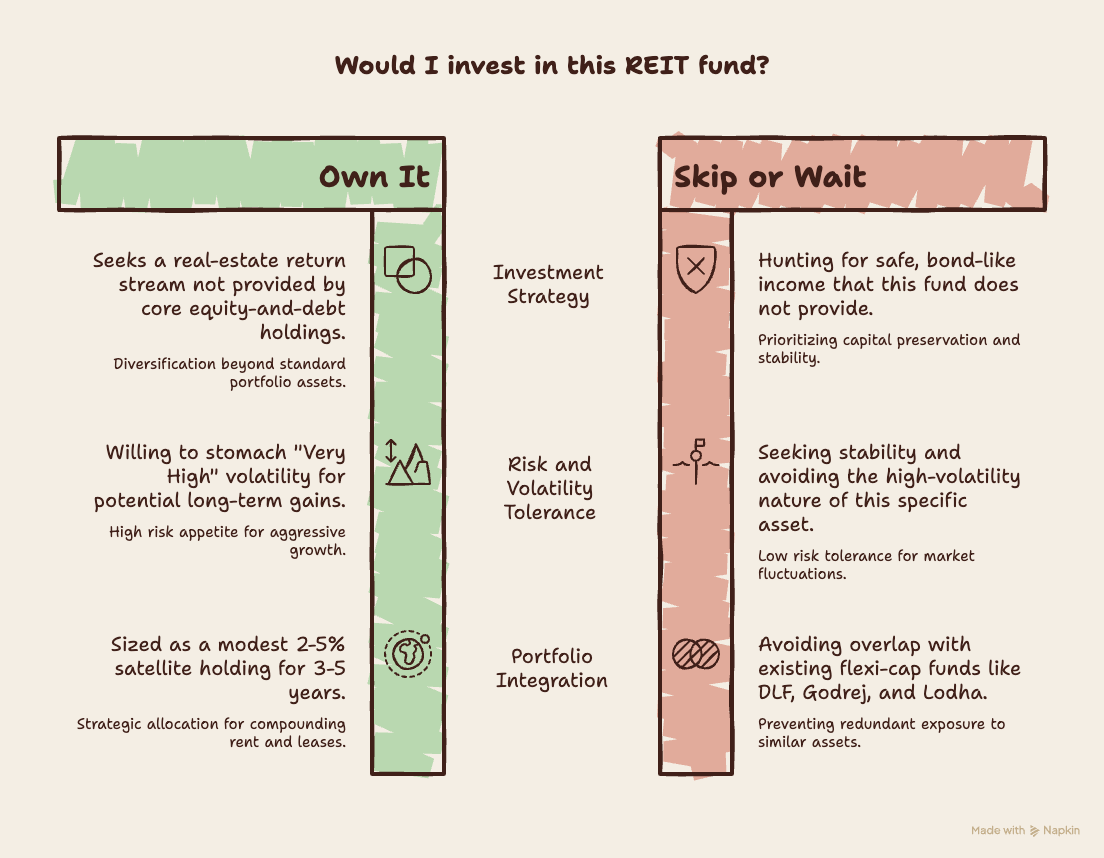
The one-line takeaway : A clever, diversifying way to own India’s commercial property — as long as you buy it as real-estate equity with an income cushion, not as a high-yield safe haven.
New instruments reward the people who understand them before the crowd does. I write these so you can make your own call, not take mine. If it earned a few minutes of clearer thinking today, share it with a friend who invests — and hit subscribe so the next breakdown finds you.
This is an educational breakdown of a New Fund Offer, built from the fund house’s own presentation plus public market data. It is not investment advice, and nothing here is a recommendation to buy or sell. The fund is rated “Very High” risk. Figures are point-in-time and will change. Do your own research and talk to a SEBI registered MF Distributor/Research Analyst/Adviser before investing.
Sources.
Primary:
Edelweiss Mutual Fund NFO presentation for the Nifty REITs & Realty Index Fund (fund facts, portfolio, performance, GAV/market-cap, distributions and tax illustration).
External, market data:
RBI repo rate 5.25% and neutral stance (newsonair.gov.in; tradingeconomics.com);
SEBI's reclassification of REITs as equity effective 1 Jan 2026 with index inclusion from 1 Jul 2026 (Business Standard; IndMoney);
Edelweiss as first AMC to file a combined REITs-and-realty index fund, and existence of pure Nifty Realty peer funds (Cafemutual; HDFC/Nippon/Motilal Oswal);
Pure Nifty Realty fund expense ratio and returns (Tickertape; Groww);
Indian REIT distribution yields (Business Standard; Motilal Oswal).