For the first time in 17 years, India’s microfinance sector didn’t implode because of a government ordinance, a demonetisation, or a pandemic. It collapsed under the weight of its own ambition. Here’s what eight quarters of management commentary reveals about the crisis — and what it tells you about cyclical credit investing.
March 2024. India’s microfinance industry was in a celebratory mood.
Asset quality had recovered from the pandemic. Disbursements were at record highs. The managing director of CreditAccess Grameen — the country’s largest pure-play microfinance NBFC — was guiding for 23–24% portfolio growth, 5.4% ROA, and ROE above 23%. Satin Creditcare’s HP Singh called FY24 a “momentous chapter” in the company’s 33-year journey. Muthoot Microfin’s CEO saw a clear path to 4.5% ROA.
And then, in a concall that few people paid enough attention to, Ashok Vaswani — freshly assigned as MD & CEO of Kotak Mahindra Bank — said something that cut against every prevailing narrative.
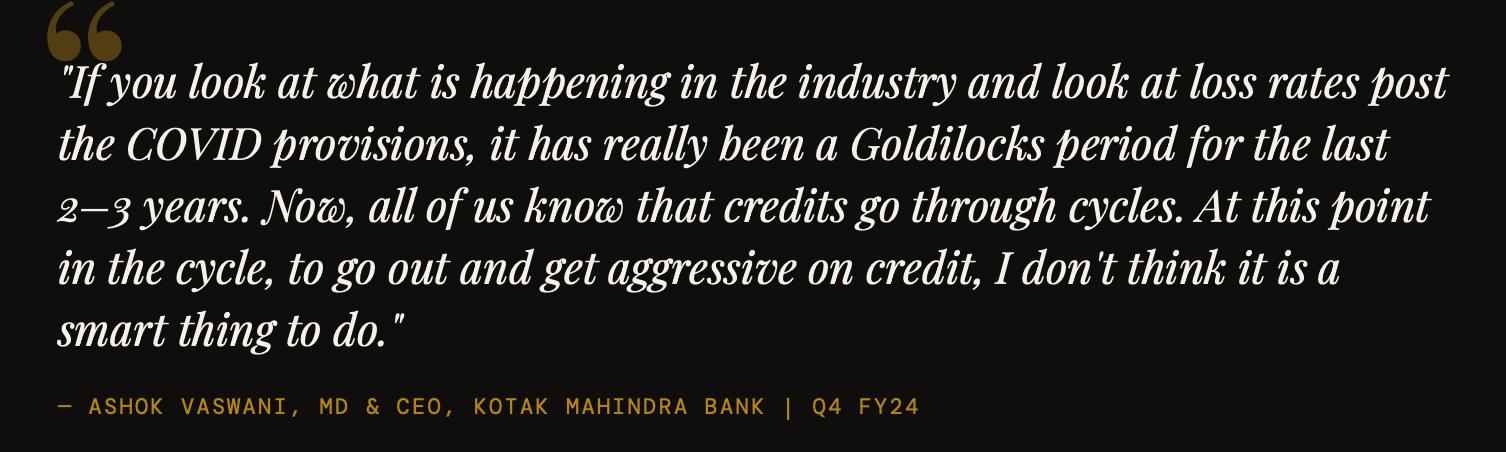
He was outvoted by the data. Or so it seemed.
18 months later, the Indian microfinance industry had shrunk by 27%.
Spandana Sphoorty had posted a ₹1,035 crore annual loss.
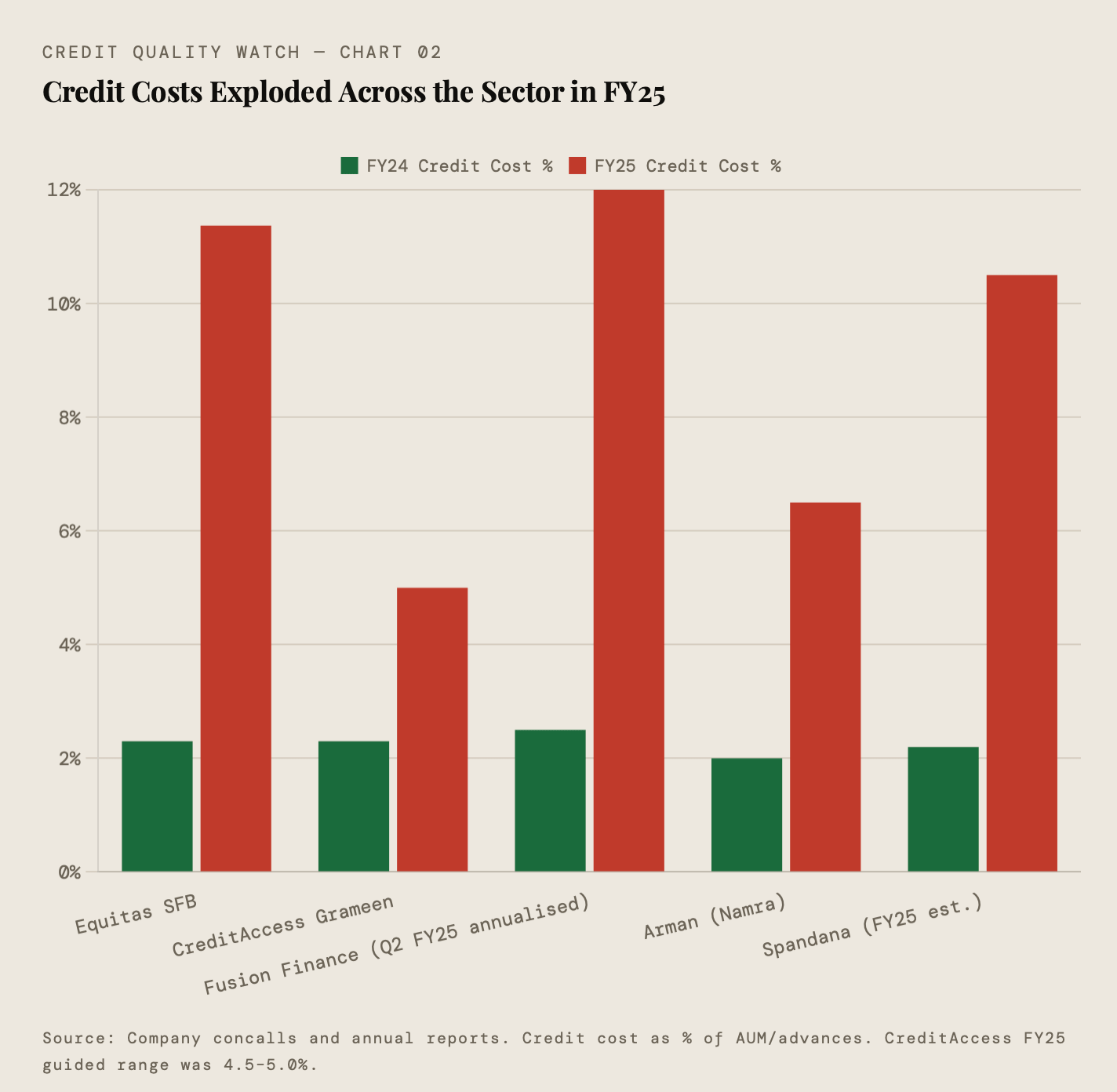
Equitas SFB’s MFI credit cost had gone from 2.3% to 11.37% in a single year.
IndusInd Bank had disclosed ₹1,885 crore in hidden NPAs.
And P.N. Vasudevan of Equitas — who had spent 17 years navigating the industry — said something that no analyst had ever said before.

This is the story of a credit cycle that the industry built with its own hands. And what it teaches every credit investor about the difference between risk management and risk theatre.
The Goldilocks Trap
I’ve spent a decade inside banking and credit risk. I’ve helped Analytics teams built models for Rural portfolios. And the single most dangerous phrase in credit is: “we’re not expecting any known risks.”
That’s almost verbatim what the MD of CreditAccess said in Q4 FY24, when asked about risks on the horizon. He wasn’t being careless. He was being accurate, in the narrow sense. Every prior microfinance crisis — Andhra Pradesh 2010, demonetisation 2016, COVID 2020 — had been triggered by an external shock nobody modelled for.
The problem was that the 2024 crisis was already inside the system. It just wasn’t visible yet.

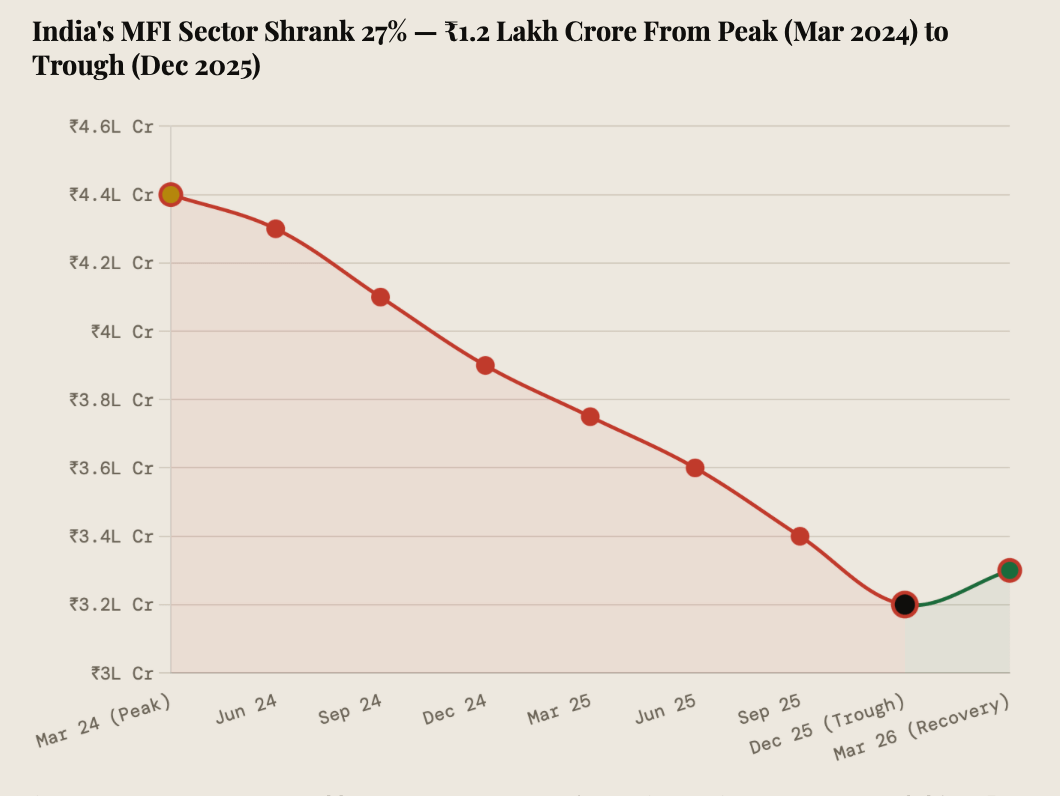
That ₹1.2 lakh crore that disappeared wasn't just a statistic. It was credit that was available to 7.8 crore borrowers — withdrawn over 21 months as the industry corrected its own excesses. The borrowers at the bottom paid the price first. By March 2026, the first green shoots of recovery pushed GLP back up to ₹3.3L Cr — but the sector had been permanently repriced.
What Actually Broke — The Overleveraging Time Bomb
The Joint Liability Group model is a genuine innovation. Five to ten women from the same village, collectively guaranteeing each other’s loans. Social pressure replaces physical collateral. In normal times, it produces repayment rates of 98–99% — rivalling the best secured lenders in the world.
But the model has one critical blind spot. It doesn’t control how many groups a single borrower joins.
Between 2022 and 2024, something quietly shifted. Post-COVID, credit demand was real and powerful. MFIs, flush with fresh equity and cheap bank lines, disbursed aggressively. Borrowers who previously had loans from two lenders took on debt from four, five, even six institutions simultaneously. Credit bureaus were slow to reflect the accumulation. The system was building explosive pressure — and nobody wanted to be the first to stop lending.
THE DATA NOBODY WANTED TO SEE
Fusion Finance’s MD disclosed in Q1 FY25 that 33% of their customers had outstanding debt greater than ₹1 lakh across microfinance loans — up from 23% just twelve months earlier. That’s a 10 percentage point jump in over-indebtedness in a single year. Spandana’s data quantified the damage more starkly: borrowers with five or more lenders were just 12% of the AUM but contributed 21% of the arrear bucket.
The trigger, when it came, didn’t need to be dramatic. A brutal heatwave across northern India in summer 2024 disrupted agricultural incomes. General elections in April–May brought organised “Karj Mukti Andolans” — loan forgiveness campaigns that told borrowers simply to stop paying. In Punjab, PAR spiked to 32%. For context, neighbouring Haryana saw no such campaign and held at 8%.
An over-leveraged system with no buffer doesn’t need a big shock to break. It needs any shock at all.
Into the Storm — Eight Quarters of Pain
The following timeline is drawn almost entirely from what management said on their own concalls. I’ve watched quite some of these calls over my career to know that the language people use under pressure tells you more than the numbers alone.
Q4 FY24 - The Goldilocks Peak
Record disbursements. Ambitious guidance across the sector. CreditAccess targets 23–24% growth, 5.4% ROA. IDFC First’s JLG collection efficiency at 99.7%. Bandhan declares pandemic legacy “decisively behind us.”
Q1 FY25 - First Tremors
Heatwave disrupts collections. Election-era loan forgiveness campaigns in multiple states. IDFC First’s collection efficiency slips from 99.7% to 99.2%. Half a percentage point. In microfinance, a red alert.
Q2 FY25 - Into the Storm
No heat wave. No elections. Collections deteriorate anyway. Vasudevan: “The industry was caught by surprise.” CreditAccess slashes ROA guidance from 5.4% to 3.0–3.5%. Fusion reports ₹693 Cr quarterly credit cost — triggering covenant breaches with lenders.
Q3 FY25 - The Darkest Quarter
Bandhan microfinance slippages: ₹1,196 Cr in a single quarter. Satin PAR-1 rises to 6.8%. IndusInd discloses ₹1,885 Cr in hidden NPAs. Leadership exits accelerate. But in December 2024 — the first flicker of recovery.
Q4 FY25 - The Reckoning
Equitas MFI credit cost: 2.3% → 11.37%. Wipes ₹630 Cr profit. Spandana posts ₹1,035 Cr annual loss. RBL writes JLG net NPA to zero. Industry aggregate shrinks from ₹4.4L Cr to ₹3.75L Cr.
Q1–Q3 FY26 - The Turn
Collection efficiencies across the sector return to 99.4–99.7%. Monthly PAR accretion collapses. CreditAccess achieves highest-ever Q1 disbursement. Fusion returns to profitability. MFIN CEO declares stress peak passed in February 2026.
Q4 FY2026 - The Revival
Disbursements return to normalcy as the sector was dried up for more than a year. Monthly disbursements crosses 30k crs. 90+% drop below 2% for the first time in 18months. Q4 FY26 earnings sealed the case. CreditAccess PAT +619% YoY to ₹340 Cr; monthly PAR accretion at ~7 bps (peak: 47 bps). Equitas PAT +406% YoY; X-bucket collection efficiency 99.71%. Bandhan PAT +68% YoY; dividend declared. Arman AUM at all-time high ₹2,728 Cr; disbursements +42% YoY. Even Spandana — six consecutive loss quarters — returned to marginal profit.
The Guardrails — Fixing the Future, Not the Present
In July 2024, MFIN — the sector’s self-regulatory body — introduced what became known as the Guardrails. No borrower should have loans from more than 4 microfinance lenders. Total unsecured indebtedness not to exceed ₹2 lakh. Bureau checks mandatory before every disbursement, not just at onboarding.
By November 2024, Guardrails 2.0 tightened the lender cap from 4 to 3.
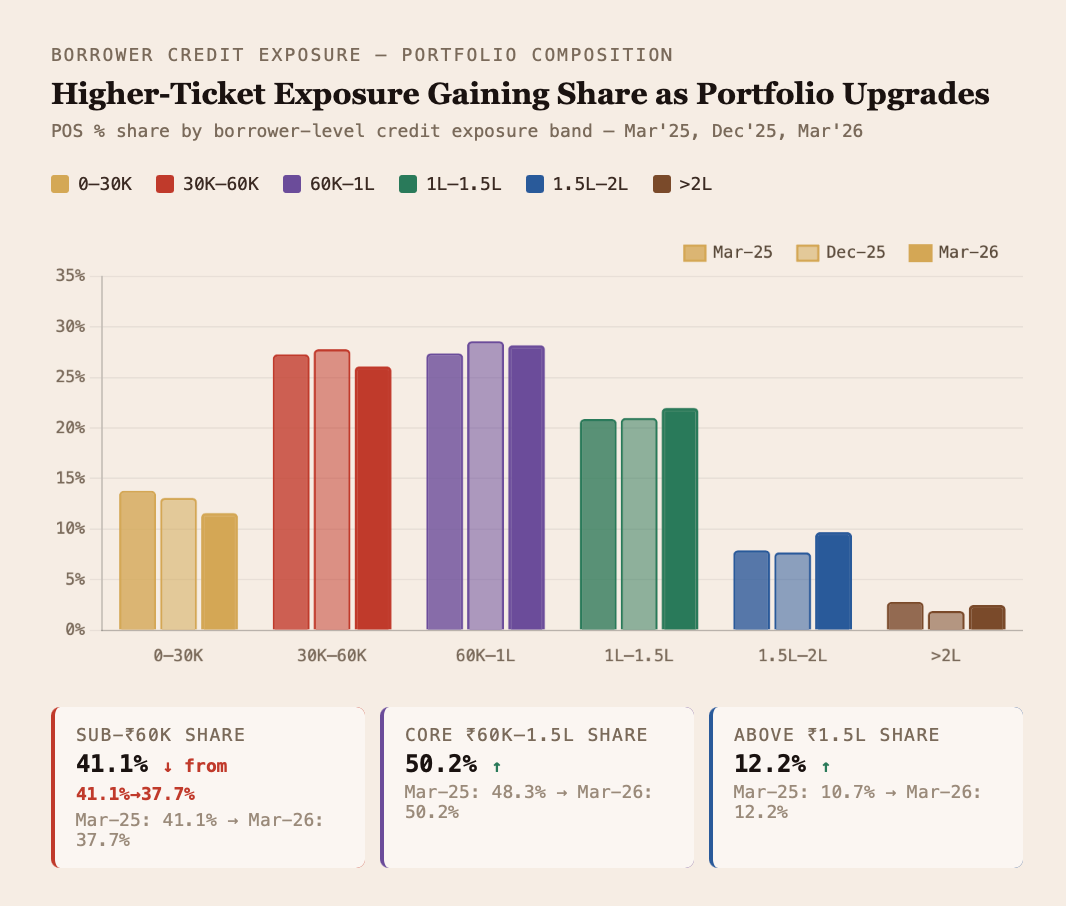
The critical point that most commentary missed: the guardrails couldn’t fix the existing book. They could only prevent the new book from being built the same way. Borrowers who already had five lenders would still default. The ₹90,000 crore in GLP contraction still had to happen. The provisions, write-offs, and leadership exits still had to follow.
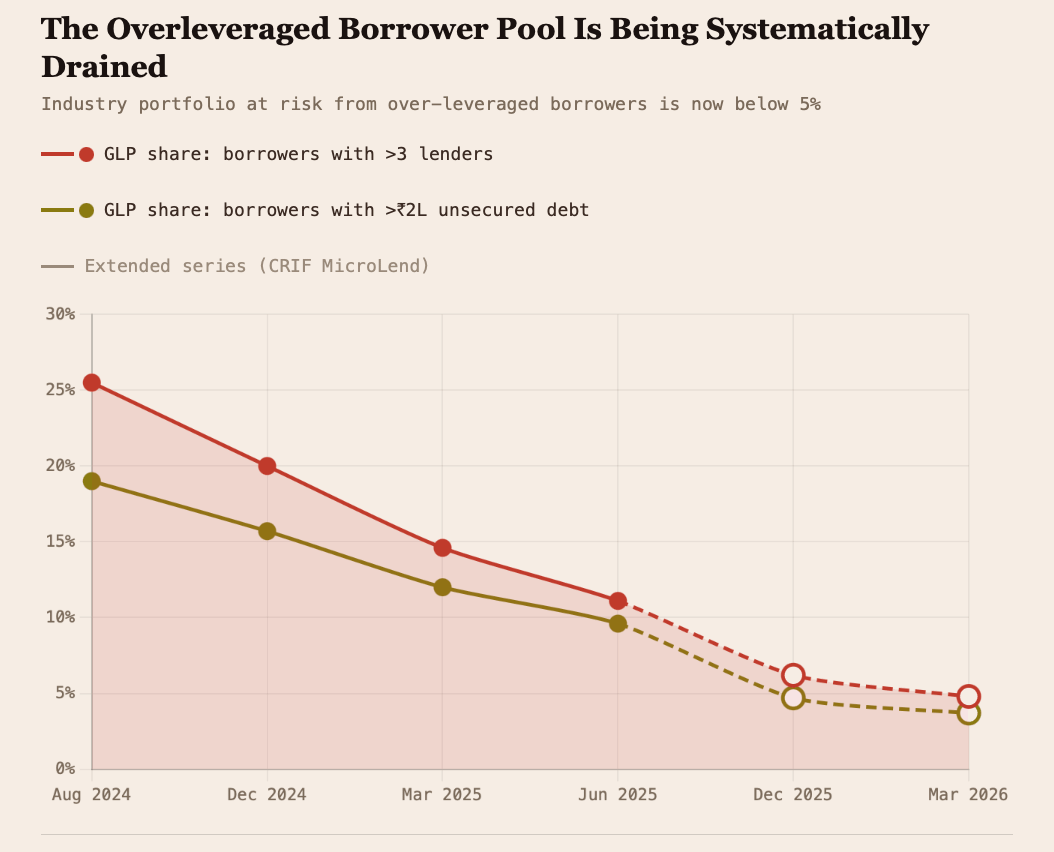
What the guardrails did was establish proof of concept for the recovery. Equitas reported that loans written under MFIN Guardrail 2.0 from January 2025 were achieving X-bucket efficiency of 99.6% — essentially identical to pre-crisis levels. Spandana’s FY26 disbursements tracked at 99.9% collection efficiency. The problem had been in the origination standards. Fix the standards, and you fix the forward book.
What the Numbers Are Actually Telling You
I want to zoom in on one data series that I think captures the full arc of this crisis better than any other single metric.
Look at what happened to quarterly impairment costs at Namra Finance — the MFI subsidiary of Arman Financial Services, one of the few players that navigated this cycle without a catastrophic balance sheet event.
RECOVERY SIGNAL : Namra Finance -Impairment Costs Declining at Pace
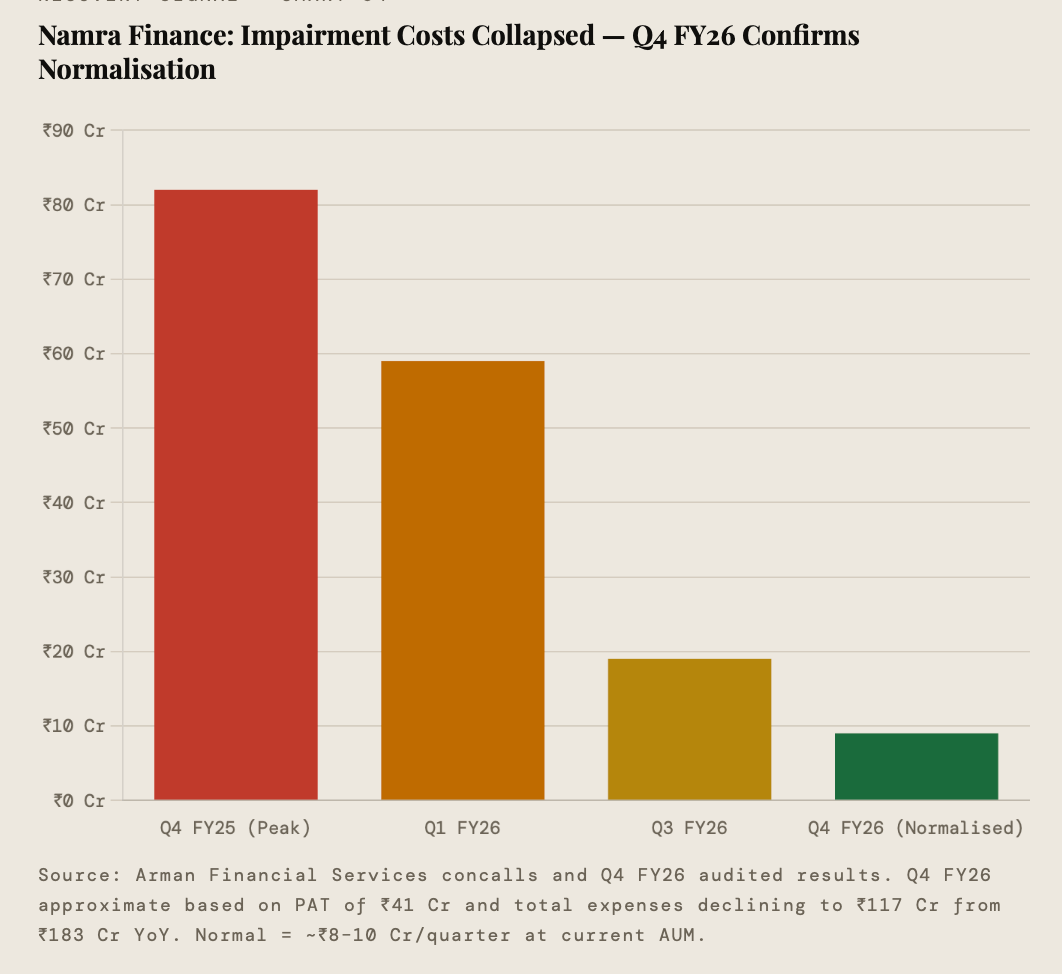
That trajectory — from ₹82 Cr to ₹19 Cr in three quarters — is what a genuine credit cycle recovery looks like in practice. It’s not a straight line. It’s also not a recovery in the old NPA bucket; those loans still need to resolve through write-offs and CGFMU claims. What’s changing is the rate of new stress formation. The pipeline is clearing.
The broader sector data confirms the same direction with Q4 FY26 numbers now in hand. CreditAccess reported monthly PAR accretion at just ~7 basis points in Q4 FY26 — down from 47 bps at the cycle's peak and 18 bps in December 2025. Equitas X-bucket collection efficiency hit 99.71%. Fusion's collection efficiency reached 99.75% in core operating states. This is no longer a recovery in management commentary. It is a recovery in audited P&Ls.
What Changed Permanently
The industry that survived this cycle is not the one that entered it. The changes are structural, not cosmetic.

Vasudevan put it plainly in Q4 FY25: “Post-COVID, we thought 3% was normal credit cost for microfinance. Post this 2024 overleveraging crisis, probably anywhere between 3–4% could be a normal credit cost.” The industry has recovered, but to a worse steady state than before. The premium for lending to this segment has been repriced — not by a regulator, but by experience.
Kotak Mahindra went furthest: it replaced the JLG model itself with individual credit underwriting and machine learning-based repayment propensity models. That’s a quiet admission that the foundational innovation of microfinance — social collateral — had weakened when a borrower could hold five different group memberships simultaneously.
The Mental Model That Explains It All
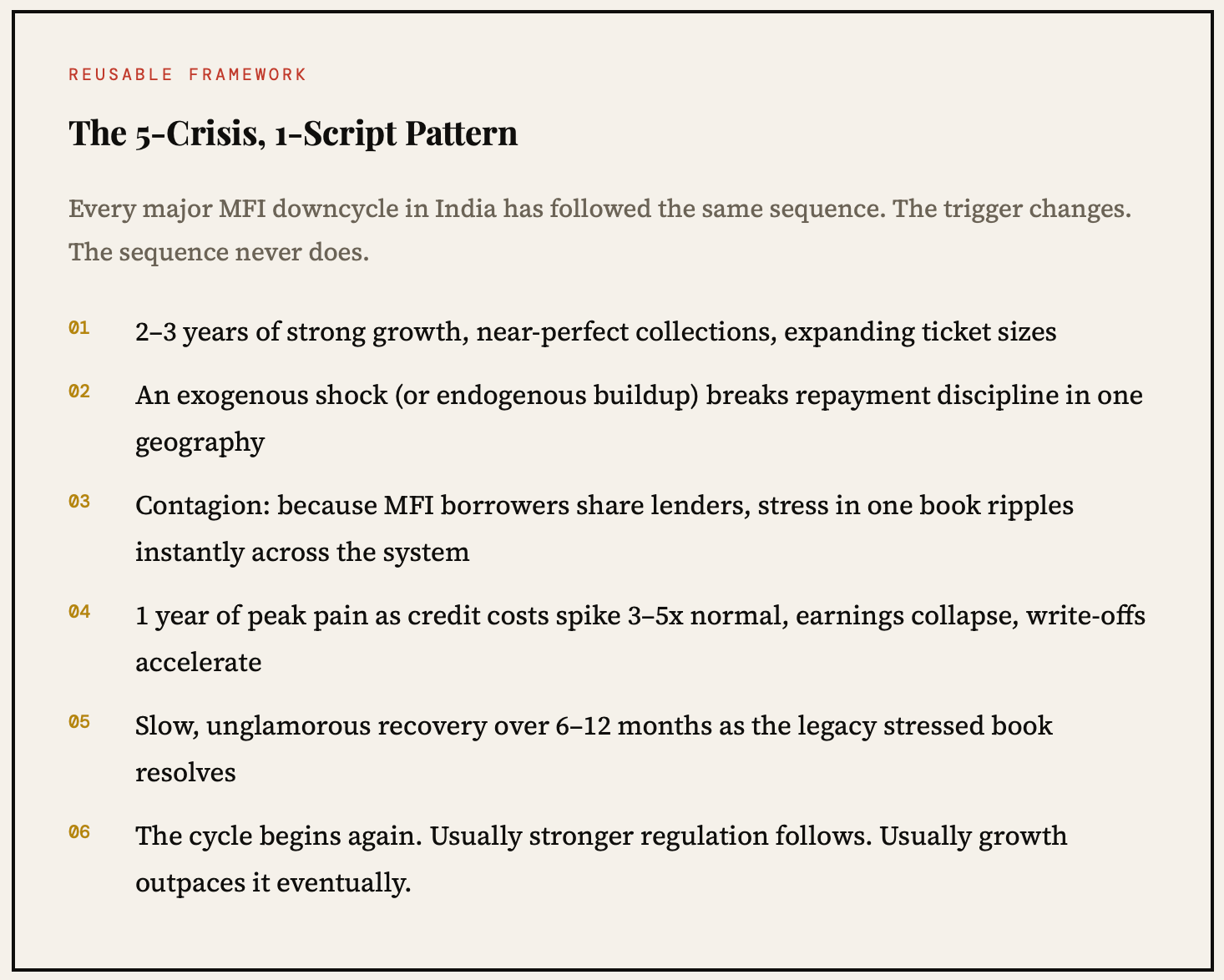
The 2024 cycle was different in one specific way: steps 1 and 2 were the same entity. The industry itself generated the shock. The competition to lend, the race to grow AUM, the willingness to ignore overleveraging signals in credit bureau data — that was the exogenous trigger. It came from inside the building.
That’s why Vasudevan’s statement matters so much as a diagnosis. Previous cycles trained the industry to look for external threats. This one was hiding in their own disbursement data.
What I Take Away
I’ve spent time building credit models for MFI portfolios. There are some things I observe from this cycle that I don’t see discussed enough.
First, collection efficiency is a lagging indicator. By the time it slips from 99.7% to 99.2%, the overleveraging that caused it has been building for 18 months. The real leading indicator is bureau data on loans-per-borrower at the portfolio level — and most lenders were watching it but not acting on it.
Second, the “known vs unknown risk” framing is a cognitive trap. Every credit crisis feels unknown when it’s building. The Andhra Pradesh crisis looked like a political risk. Demonetisation looked like a policy risk. This one looked like collection seasonality. They all feel external because you’re inside the system that’s creating them.
Third, the cycle doesn’t punish bad operators equally. The companies that provisioned early (HDFC Bank, IDFC First, Arman Financial) came out of this with clean books and growing disbursements. The companies that denied the systemic nature until Q2 FY25 came out with governance crises, leadership exits, and covenant breaches. The outcome gap between disciplined and undisciplined operators in a downcycle is enormous — and it shows up before the recovery, not after.

This is one of the most honest line I’ve read from any microfinance executive in years. The sector has survived every crisis it has faced. It has also generated every crisis it has faced. Understanding which one is coming — internal or external — is the real work of credit risk.
The cycle appears to have turned. The guardrails are working. The new book is performing. Q4 FY26 audited results confirm it across the board.
CreditAccess PAT surged 619% year-on-year.
Equitas PAT surged 406%, X-bucket collection 99.71%
Arman Financial hit an all-time high AUM, disbursements +42% YoY
Even Spandana — which posted six consecutive loss quarters — returned to marginal profit.
One outlier: Utkarsh SFB, full-year FY26 loss ₹1,151 Cr, GNPA still at 7.7% — the sector's last stressed pocket.
The companies that provisioned early, disbursed conservatively, and refused to deny the systemic nature of this crisis are now entering FY27 with clean books, confirmed FY27 guidance of 20–25% AUM growth, and credit costs expected at 3–4% — the new steady state the industry has accepted as the cost of lending to this segment responsibly. For patient investors who understand how financial cycles behave, this is likely a more interesting entry point than the one in March 2024 — when everyone was confident and the real risk was already inside the system.