Read time: 8 minutes
On March 20, 2026, the Ministry of Finance quietly launched the Credit Guarantee Scheme for Microfinance Institutions – 2.0 (CGSMFI-2.0). The press release ran two pages. Most people skimmed the headline and moved on.
Buried inside the operational guidelines is a scheme design that tells you a lot about the state of India’s microfinance sector, how the government thinks about credit risk, and — if you’re a banker or a finance professional — what the next 100 days look like for MFI lending.
Let’s pull it apart.
First, the context you actually need
The MFI sector in India has been under stress since Mar’24. This isn’t a secret, but it’s worth stating plainly before we get into the scheme mechanics.
Over the past 12–18 months, delinquencies in the microfinance portfolio have risen sharply. The RBI flagged it. Lenders responded by pulling back. The consequence is predictable and painful: smaller MFIs — the ones operating in the most underserved geographies, serving borrowers with the thinnest credit profiles — started running out of funding.
Banks, doing what banks do when things get uncertain, tightened underwriting on MFI loans. SROs released guardrails for rule based underwriting. The credit tap slowed. And the last-mile borrower — a vegetable vendor in rural Bihar, a small trader in coastal Odisha — started feeling it.
CGSMFI-2.0 is the government’s response to that credit freeze. It’s not stimulus. It’s not a bailout. It’s a guarantee mechanism — and understanding the difference matters.
What a credit guarantee actually does (and doesn’t do)
A lot of people read “₹20,000 crore guarantee” and assume the government is spending ₹20,000 crore. It isn’t.
Here’s how it works:
The National Credit Guarantee Trustee Company (NCGTC) — a wholly government-owned entity under the Ministry of Finance — issues guarantees to banks and financial institutions (called Member Lending Institutions, or MLIs under the scheme). Those banks then lend to NBFC-MFIs and MFIs. The MFIs use that money to on-lend to small borrowers.
If an MFI defaults on its loan from the bank, NCGTC pays the bank a portion of the loss. That’s the guarantee. The government only spends money if there’s an actual default — and even then, only a fraction of the defaulted amount.
This is the partial credit guarantee (PCG) model. It’s widely used in development finance globally — the World Bank, IFC, and most multilateral development banks use variants of it. The logic is elegant: government absorbs the fear of lending. Private capital does the actual lending. The borrower gets credit she otherwise wouldn’t have gotten.
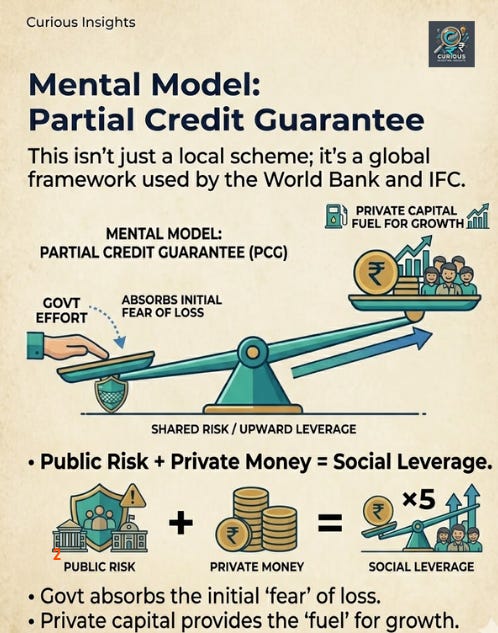
Think of it as a risk transfer mechanism, not a funding mechanism. The government is not writing cheques. It’s writing insurance.
The three-layer credit stack
The money moves through a chain. Understanding each layer is important if you want to assess where the risk actually sits.
Layer 1 — NCGTC (Guarantee Provider) NCGTC provides the guarantee cover. It doesn’t lend. Its exposure is contingent — it pays only if the MFI defaults on the bank loan. The guarantee fee it collects (0.5% p.a. on sanctioned amount in year one, on outstanding amount thereafter) is meant to build a claims reserve.
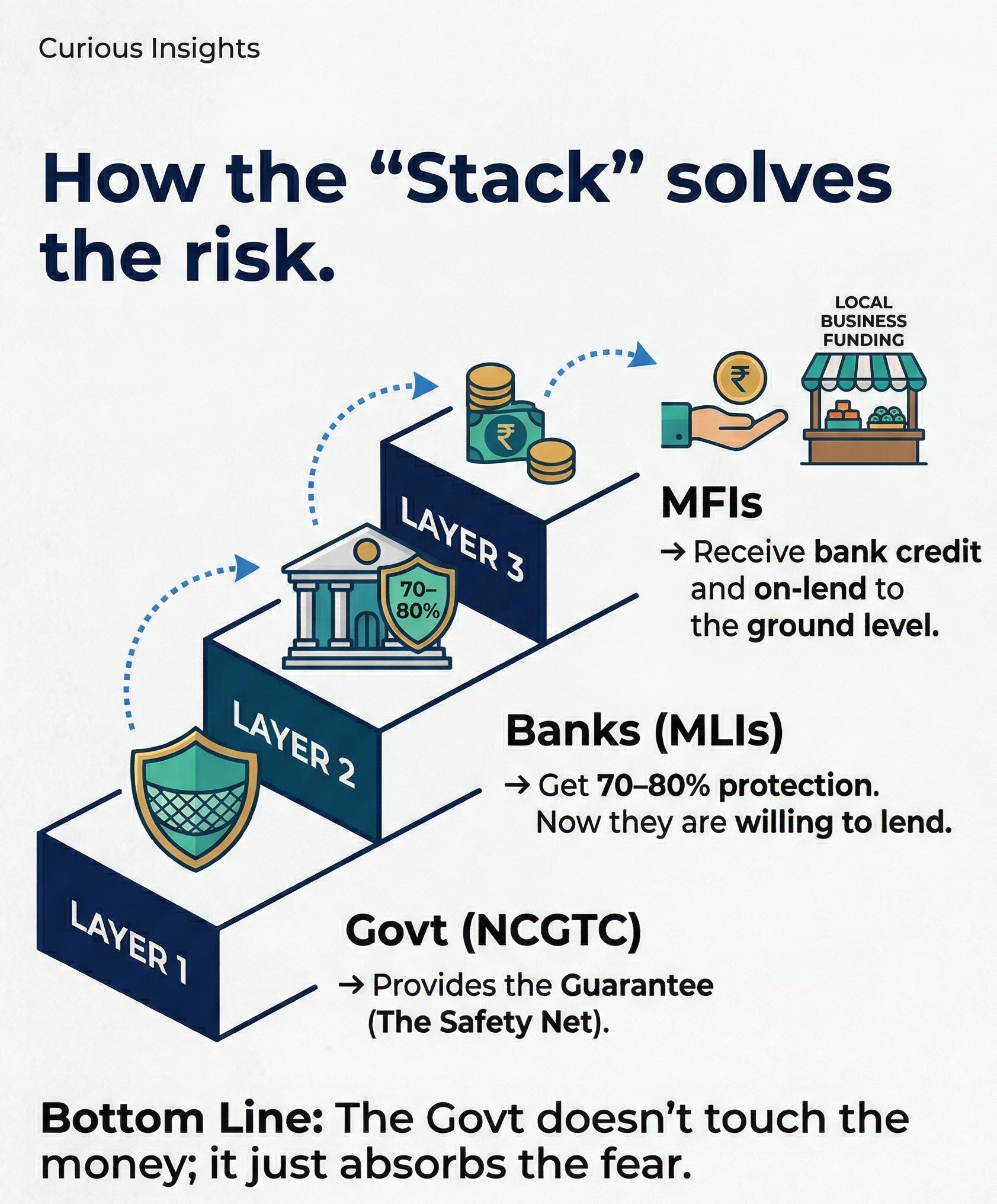
Layer 2 — Banks / Financial Institutions (MLIs) These are Scheduled Commercial Banks and All India Financial Institutions that register as MLIs (Member Lending Institutions). They are the actual lenders to MFIs. Their interest rate is capped at EBLR or 1-year MCLR + 2% p.a. — meaning the government has put a ceiling on how much they can charge the MFI for this protected money. With 70–80% of their downside guaranteed, the risk-adjusted return on these loans looks significantly better than unsecured MFI lending.
Layer 3 — NBFC-MFIs / MFIs (On-lenders) These entities borrow from banks and on-lend to small borrowers. Their on-lending rate is capped at 1% below their own 6-month average lending rate. This is the detail that most people miss — the government has embedded a price control for the end borrower inside a guarantee scheme. More on this below.
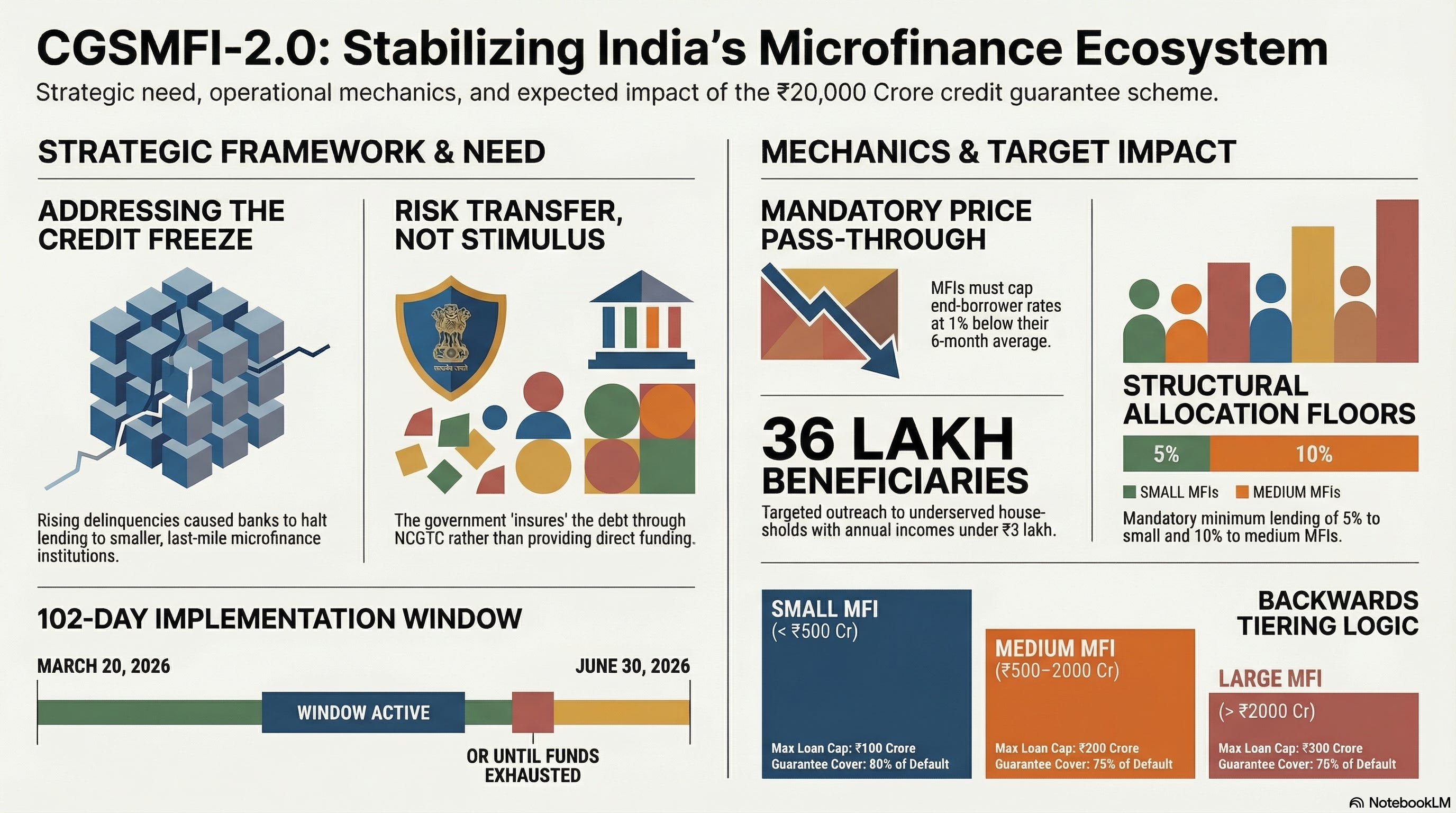
End Borrower — Eligible Small Borrowers The RBI’s regulatory definition of microfinance covers loans to households with annual income up to ₹3 lakh. These are the ultimate beneficiaries. The scheme estimates approximately 36 lakh borrowers will benefit from the incremental lending this enables.
The tiering logic — and why it’s designed backwards
Here’s where the scheme gets interesting from a design perspective.
Guarantee coverage under CGSMFI-2.0 is tiered by MFI size:
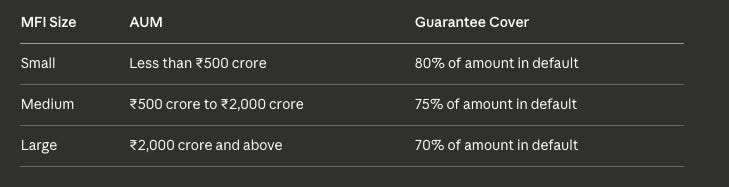
If you have a conventional banking brain, this looks backwards. Larger institutions are typically seen as safer — more diversified portfolios, stronger systems, better governance. Why give them less protection?
Because the goal of this scheme isn’t to make banks comfortable lending to large MFIs. Large MFIs can manage. The goal is to push capital toward small MFIs — the entities most likely to be frozen out of credit markets right now, and the ones most likely to be serving the most underserved borrowers.
The scheme reinforces this with a mandatory allocation floor: at least 5% of total loan amounts under the scheme must go to small MFIs, and at least 10% to medium MFIs. This means large MFIs cannot absorb the entire ₹20,000 crore pool. Capital is structurally directed toward the fragile end of the ecosystem.
The loan caps also reflect this hierarchy:
Small MFIs: maximum ₹100 crore per MFI (capped at 20% of their AUM)
Medium MFIs: maximum ₹200 crore per MFI
Large MFIs: maximum ₹300 crore per MFI
The price control nobody noticed
This is the part of the operational guidelines that deserves more attention than it’s getting.
Standard guarantee schemes protect the lender’s downside. They don’t touch pricing at the end-borrower level. CGSMFI-2.0 does.
The guidelines require that MFIs cap their lending rate to small borrowers at 1% below their own average rate of lending over the past six months. The MLI — the bank — is responsible for monitoring compliance with this.
Think about what this means in practice. The government isn’t just saying “we’ll absorb your credit risk so you’ll lend.” It’s saying “we’ll absorb your credit risk, but the benefit has to pass through to the borrower, not stay with the MFI as a margin improvement.”
This is a deliberate policy choice. MFIs that use this scheme to raise cheaper funding cannot pocket the spread. They have to cut the rate to the end borrower.
Whether this is effectively enforceable at scale is a different question. The monitoring mechanism — quarterly bureau reports, statutory auditor certificates within six months of disbursement — creates a compliance trail, but enforcement has historically been the weak link in India’s MFI regulation.
What the 100-day window tells you
The scheme runs from March 20 to June 30, 2026. That’s roughly 102 days, or until ₹20,000 crore in guarantees are issued — whichever comes first.
The urgency is intentional. This is a targeted intervention in a crisis, not a long-term structural programme. The government is essentially opening a window and saying: if you move fast, there’s guarantee support available. If you don’t, the window closes.
For MFIs and MLIs, the clock starts now. MLIs need to register with NCGTC, submit an undertaking, and sanction loans — with full disbursement within three months of sanction. Given the operational requirements (bureau reports, auditor certificates, separate accounts per borrower), the administrative lead time is real.
The scheme’s one-year moratorium plus two-year repayment structure (maximum three-year tenure) is well-suited to the MFI model, which typically runs 12–24 month loan cycles.
What this means if you’re watching the MFI sector
A few things worth tracking as this unfolds:
Which MFIs draw down fastest. The MLIs willing to lend first — and the MFIs that receive it — tell you which institutions have the relationship infrastructure and compliance readiness to move quickly. That’s an indirect signal of operational quality.
Whether the small MFI floor gets met. The 5% allocation to small MFIs sounds modest, but given how credit-starved small MFIs are, even that quantum could be meaningful for individual institutions. Watch whether it actually flows or gets absorbed by medium and large MFIs who can move faster.
Delinquency trends through Q2 FY27. The scheme’s success ultimately depends on whether the fresh lending actually performs. If MFI portfolio quality continues to deteriorate, the guarantee claims will start flowing — and that’s when we’ll find out whether NCGTC’s reserves are adequate.
Regulatory response. The interest rate cap and monitoring requirements embedded in this scheme are consistent with the RBI’s tightening posture on MFI pricing over the past two years. Watch for whether the regulator formalises some of these pricing norms beyond the scheme window.
The bigger picture
CGSMFI-2.0 is not a transformative reform. It’s a stabilisation measure — a short-duration, targeted intervention to restore credit flow to a sector that provides financial access to India’s most economically vulnerable households.
The mechanism is sound. The PCG model is globally proven. The tiering logic is thoughtful. The price pass-through requirement is ambitious.
Whether it works depends on execution — how fast MLIs register, how quickly money flows to small MFIs, and whether the monitoring infrastructure can actually enforce compliance.
But here’s what’s easy to lose in the technical details: at the end of this three-layer chain, there is a borrower who currently cannot access credit. Who is being served by an informal moneylender at 36–48% interest. For whom ₹20,000 means the difference between buying inventory for her small shop or not.
Policy doesn’t always reach her. This one, if it works, might.
If you found this useful, forward it to one person in your network who works in banking, credit, or financial inclusion. That’s how this newsletter grows — one reader at a time.
Have a question about the scheme mechanics or want me to dig into a specific aspect? Reply to this email — I read everything.
About this newsletter: I write about financial markets, policy, and investing frameworks — for people who want to understand how money actually moves, not just what the headlines say.